Two Decades of Nuclear Hype & No Lessons Learned: The Energy Policy Act Turns 20
How federal incentives created Plant Vogtle’s $36 billion disaster—and now threaten to repeat history.
In May 2024, Georgia Power marked the completion of two new nuclear reactors at Plant Vogtle, the first reactors built in the United States in over three decades. Rather than a moment of triumph, the project has become a stark symbol of misplaced priorities, government overreach, and utility profiteering. With a final price tag of $36 billion—more than $20 billion over budget—and a timeline that stretched seven years beyond the original schedule, Plant Vogtle is now the most expensive power plant ever built on Earth. For Georgia ratepayers, this is not an abstract financial disaster—it’s one they are paying for directly, and will be for decades to come.
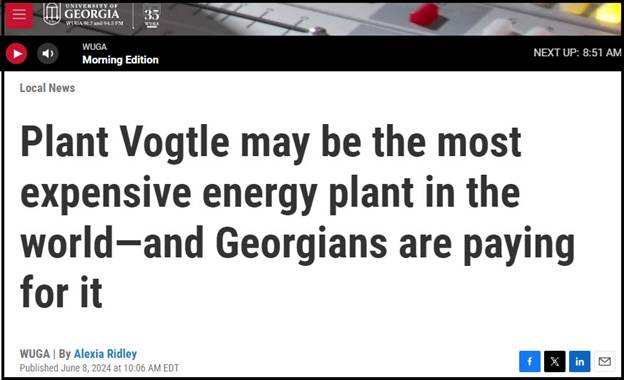
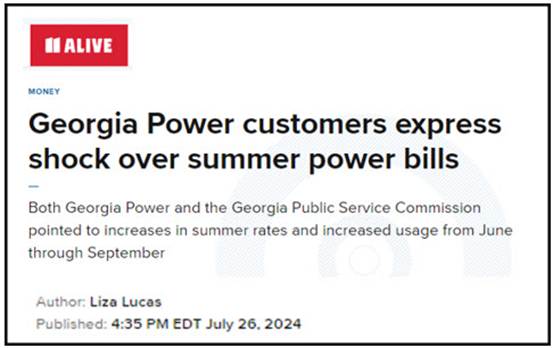
The scale of Vogtle’s impact on Georgia consumers is unprecedented. Long before a single watt of electricity flowed from the new reactors, residential customers had already paid approximately $1,000 each through early financing charges—effectively subsidizing the construction before the reactors were finished with no guarantee of performance or accountability. Once the two nuclear reactors (Units 3 & 4) went online, customers saw a jarring 23.7% increase in their electric bills. This was in stark contrast to repeated assurances over the years that rate increases would be modest, falling in the range of 2–3%. The actual outcome was nearly ten times that, a betrayal of public trust that raises serious questions about regulatory oversight and utility transparency.
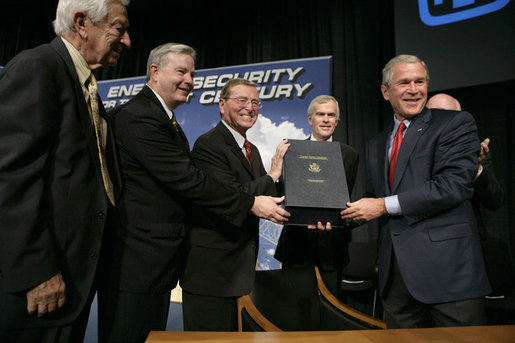
The only reason Vogtle’s expansion happened at all is because of the Energy Policy Act of 2005. This law, passed in the wake of renewed interest in carbon free electricity, offered federal incentives that distorted market realities. It included generous loan guarantees, production tax credits, and federally backed insurance (known as the Price Anderson Act, recently extended for another 40 years) because private insurance will not touch nuclear power with its catastrophic meltdown risks. These federal incentives made nuclear power development palatable to utilities and investors who otherwise would avoid high risk ventures. In Vogtle’s case, the project was supported with a staggering $12 billion in Department of Energy (DOE) loans. Without these taxpayer-backed subsidies, no private investor or utility would have dared to take on a project of this magnitude.
Now, twenty years after the passage of the 2005 law, the same false claims of “this time will be different” are being repeated. Instead of learning from Plant Vogtle’s delays, budget overruns, and the financial burden placed on everyday Georgians, federal leaders have chosen to double down. On July 4, 2025, Congress passed the latest tax package supported by the Trump administration, including provisions that once again favor nuclear power development over actual affordable, proven energy technologies such as wind, solar, and energy efficiency, with lucrative tax breaks and faster permitting processes.
But the poor economics of new nuclear power have not changed. It remains one of the most expensive and slowest forms of energy generation to bring online. It requires decades of upfront investment, all while cheap, fast, clean and safe alternatives—like wind, solar, and battery storage—continue to fall in price and improve in reliability.
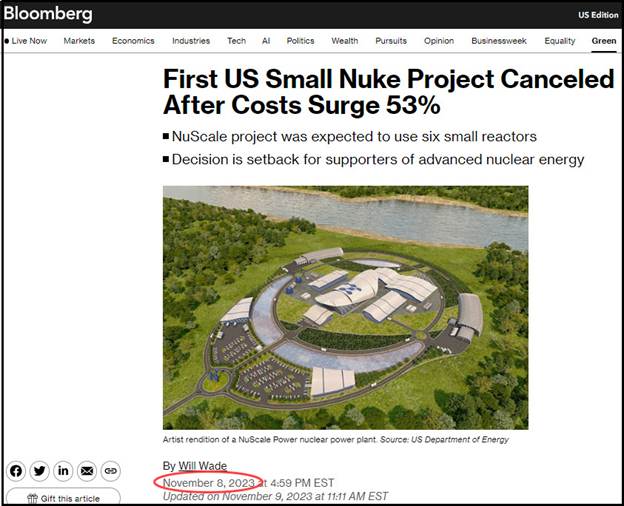
Nuclear proponents pin their hopes on “small modular reactors” (SMRs) and “next generation” so-called “advanced” designs which promise to be different, similar to promises that were made for new nuclear leading up to passage of 2005 Energy Policy Act: “modular designs” and “streamlined permitting”. There was nothing different then and there’s nothing different now: Projects like the failed NuScale/UAMPs reactors in Idaho to power Utah communities had costs skyrocket and timelines slip, just like traditional reactors. SMRs not only bring no cost savings, but they introduce new problems of nuclear waste scattered across the country and increased security risks at every site. It’s the same old nuclear issues—just multiplied and repackaged with much more hype.
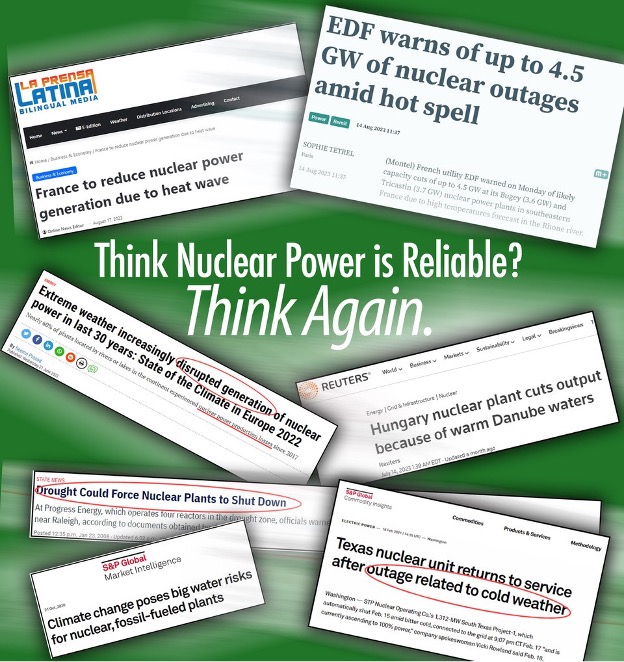
Meanwhile, the climate clock is ticking: 2024 was the hottest year in recorded history. If the goal is to reduce CO2 emissions quickly, nuclear power is simply too slow. Plant Vogtle’s two reactors (just over 2000 Megawatts) took 15 years from initial planning to completion. We cannot wait that long for solutions. Even worse, there have been no studies on the reliability of nuclear power plants to withstand extreme weather due to climate change. Early indications are that nuclear power is not reliable during droughts, heat waves, and arctic blasts.
Finally, the enormous financial resources tied up in nuclear projects could be deployed much more effectively in renewable energy, grid modernization, efficiency programs, and climate resilience. Instead, policymakers block affordable rooftop solar at the urging of monopoly utilities and pour public taxpayer funds into nuclear projects that offer no short-term emissions benefits and very real long-term financial risks. Socialize the risk, privatize the profits.
And what of the ratepayers? They bear the cost without a say. They are the ones who see their monthly bills go up while utility shareholders reap guaranteed profits from state-approved construction work in progress (CWIP) charges and other rate mechanisms. In Georgia, this model has led to a perverse outcome: failure is rewarded, and success—delivering affordable, clean energy on time and on budget—is not incentivized.
New nuclear power is not helping ratepayers, and it’s not helping the climate. It is a high-stakes gamble that delays real action and burdens communities with unmanageable costs. The Plant Vogtle debacle is a cautionary tale – a model for how bad policy, corporate influence, and regulatory negligence can distort our energy future. Unfortunately, too many people, including federal lawmakers, failed to learn from these mistakes and have been fooled by the nuclear industry and its proponents once again. If we continue down this path, it won’t just be Georgians that pays the price—it will be all of us.
Patty Durand is the director of Georgians for Affordable Energy, a nonprofit organization that seeks utility reform in Georgia. Patty has an energy background and ran for a seat on the Georgia Public Service Commission in 2022.