Utah’s Nuclear Gambit: a Candle in the Wind

By Patty Durand
A recent ad run by the Utah Office of Energy Development proclaiming “Nuclear energy is cleaner than a candle” is designed to make readers see nuclear power as simple, harmless, and environmentally friendly. But the comparison reduces a deeply complicated and enormously expensive technology into a catchy slogan that ignores the real costs and consequences of nuclear energy.
Georgia is the only state in the nation to have built nuclear reactors in the last 30 years, and May is the two-year anniversary of its completion. The cost and political fall-out of Plant Vogtle has been enormous. As someone who has spent years working on utility regulation and energy policy in Georgia, I have watched the claims and promises made by nuclear power supporters collapse: at $36 billion for two new reactors, Plant Vogtle is the most expensive power plant ever built in American history.
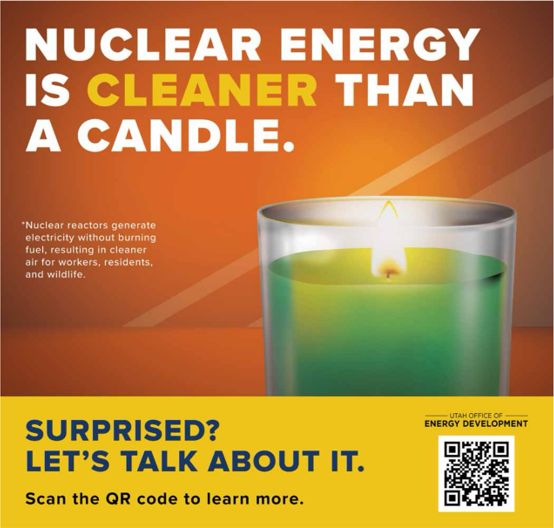
Here are some of the problems I see with this ad:
A candle does not leave behind radioactive waste that remains dangerous for thousands of years.
A candle does not require uranium mining that contaminates land and groundwater.
A candle does not create the possibility of catastrophic accidents like the Chernobyl disaster or the Fukushima Daiichi nuclear disaster.
And a candle does not saddle families and businesses with decades of soaring utility bills, as happened in Georgia beginning May 2024.
Georgians were told The Vogtle expansion was a forward-looking investment in reliable clean energy. Instead, the project became a financial disaster marked by years-long construction delays and exploding costs that led to the bankruptcy of Westinghouse. Georgia Power customers were forced to pay for the project financing during construction of approximately $1000 per household before the first electron was generated. Once the project was completed rates increased 25%, about 10 times higher than the 1-2% rate increases we were told.
Georgia Power is a monopoly and customers have no choice in their utility. Seniors on fixed incomes, working families living paycheck to paycheck, renters, and small businesses were forced to absorb the cost while shareholders remained protected. In 2025 over 270,000 Georgia Power customers were disconnected for inability to pay their high bills, or one in every nine customers. The pain and shock from the high electricity bills led to two commissioner losing their reelection bid and the political fallout continues.
Like Georgia, Utah is a top 10 sunny state. In fact, Utah was recently ranked the second sunniest state in the nation. Despite this enormous natural advantage, Utah barely ranks in the top tier of states for solar deployment. Instead of pouring billions into nuclear energy projects that will take 15 years to complete, as Plant Vogtle did, Utah could become a national leader in solar, coming in 2nd or 3rd place for installed solar instead of 10th. Pair solar with storage, which has dropped 80% in cost in the past five years, and nuclear generation has zero advantage.
Utah could aggressively expand distributed solar generation on homes, schools, parking lots, warehouses, and commercial buildings. It could invest in virtual power plants that connect rooftop solar, batteries, smart thermostats, and electric vehicles into coordinated systems that strengthen the grid during periods of high demand.
These solutions are not futuristic ideas. They are already being deployed successfully in the U.S. and across the world.
Why is nuclear being pitched across the U.S. so heavily? Because it is far more profitable: utilities and nuclear energy corporations like General Electric, Bechtel, and Westinghouse make enormous profits off the high cost of nuclear. Southern Company, the corporate owner of Georgia Power, earned such high profits in 2025 that their CEO termed it as “transformational” during their earnings call, but did not mention that one in nine Georgia Power customers were disconnected that same year.
The nuclear energy industry survives because governments protect it from risks that private investors would never accept. Ratepayers absorb overruns. Taxpayers backstop liability risks. Utilities earn guaranteed profits from construction spending even when projects spiral out of control, as happened in South Carolina for their nuclear project, Plant Summer.
The ad’s slogan also ignores one of the industry’s biggest unresolved problems: radioactive waste. The United States has no permanent disposal solution for spent nuclear fuel. Waste continues accumulating at reactor sites. It is one of the defining failures of the technology.
The real question is not whether a nuclear reactor produces less visible smoke than a candle flame. The real question is whether nuclear power is the smartest, fastest, safest, and most affordable way to build a clean energy future. Georgia’s experience with Plant Vogtle shows it is not: Nuclear power has locked us into decades of high utility costs while preventing or delaying investments in cheaper and more practical alternatives. I urge the people of Utah not to follow our footsteps.