What Georgia’s Plant Vogtle teaches us about New York’s nuclear ambitions
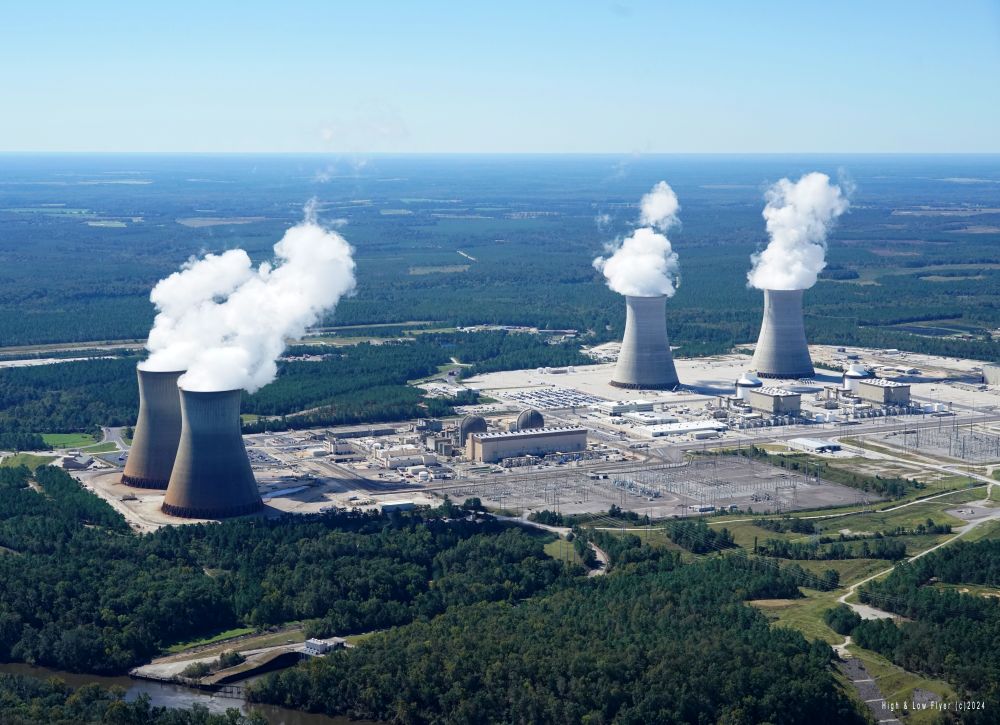
Image of Plant Vogtle courtesy of High & Low Flyer (c) 2024
This opinion editorial by former Plant Vogtle Construction Monitor Don Grace was originally published on November 13, 2025 in Crain’s New York, available here.
Just over a year ago, Georgia completed building two new reactors at Plant Vogtle, making Georgia the first state to build new reactors in over 30 years. Now that data centers are expanding to serve the needs of artificial intelligence and electrification, there are calls for rapid construction of new nuclear generation, specifically in New York State. But there’s a cautionary tale to be learned for those seeking to build the next nuclear reactor.
New York’s Governor Kathy Hochul announced in June that she was directing the New York Power Authority, the state’s public utility company, to construct a new nuclear facility somewhere upstate with the power capacity of roughly 1000MW, similar to the amount of power produced by the NRC-approved Westinghouse AP1000 reactor used at Plant Vogtle.
Now, Governor Hochul has requested the Trump administration fast track the new plant, opening the door for New York to greenlight the first nuclear reactor since Plant Vogtle, which was approved for construction in 2012.
Based on my intimate knowledge of Georgia’s Plant Vogtle project, I believe political enthusiasm for nuclear power as a panacea to our energy needs is misplaced. As a nuclear engineering professional with decades of experience and the Vogtle Construction Monitor for the recently completed reactors, I authored over a dozen reports on the progress and problems of Vogtle in filings to the Georgia PSC and testimony before the commission. In Georgia, energy generated by the new reactors cost $160/MWh, or five times more than the $30/MWh price point at which most utilities can generate electricity. Georgia’s residential ratepayers are now burdened with a 25% rate increase for a modest amount of electricity generated by the new reactors for Georgia Power’s share of the project.
It’s naïve to believe lessons learned from constructing Vogtle’s new reactors will reduce costs for the next ones because the ‘first of a kind’ is always more expensive. Yet Vogtle’s reactor design, the AP1000, is not the first of a kind – it’s a basic pressurized water reactor, a technology from the 1950s where the reactor’s core is cooled by water circulated using electrically powered pumps. There are some nuclear designs underway such as molten salt reactors or small modular reactors which are new, but these designs will not carry any reduced costs from lessons learned from Vogtle.
Even if the next reactor design is similar to Vogtle, the cost to construct the AP1000 reactor was only one of many factors for cost overruns. A drop in natural gas prices prompted the cancellation of 12 of the originally planned 14 AP1000 reactors, which then resulted in the abandonment of the modular facility which was meant to supply common modules to the plants. Hampered by the lack of experienced nuclear construction labor and an inability to properly manage completion of the project, the construction contractor ultimately declared bankruptcy.
However, even if natural gas prices hadn’t decreased, the $36 billion cost and 15-year timeline, even if improved 30%, means that nuclear generation is still far more expensive and slower to deliver than any other solution. Georgia’s new reactors support the case that nuclear energy is the only energy technology that has never gotten cheaper over time.
Seventeen years after the Plant Vogtle expansion project first was licensed, it’s clear that new nuclear is not a panacea. The staggering and ever-increasing costs, prolonged construction timeline, and significant burden on ratepayers reveal a technology that commercially speaking, remains fundamentally flawed. And that’s not even touching on the safety and long-term waste storage concerns raised by building new reactors.
The story of Plant Vogtle is not a tale of technological triumph, but a cautionary narrative for states like New York seeking to build a new nuclear reactor. If there are no limits to what is spent, anything can be completed. Until the nuclear industry can demonstrate true cost-effectiveness and technological innovation, it will remain a costly burden for ratepayers and a distraction from the work that is needed to meet our future energy needs. Don Grace served as the Plant Vogtle Construction Monitor from 2017 to 2024, providing oversight and testifying semi-annually before the Georgia PSC.
Don Grace served as the Plant Vogtle Construction Monitor from 2017 to 2024, providing oversight and testifying semi-annually before the Georgia PSC.