The following is an excerpt from an extensive article published recently by the CATO Institute and written by Steve Thomas, Emeritus Professor, Energy Policy, Business School, University of Greenwich and editor-in-chief of Energy Policy.
Despite a major public relations push in the media and with policymakers for new nuclear, the anticipated nuclear revival will not happen because of the fundamentals of the technology in terms of cost, construction time, and reliability. Commercial financiers will remain very reluctant to fund these projects if any of the risk falls on them. Nuclear projects also take far too long before a return on investment can begin to be earned, typically more than 15 years from investment decision to first power.
SMRs [Small Modular Reactors] will not meet their goals. For the technologies to succeed, it will not be enough for them to be cheaper than large reactors; they will have to compete with other low-carbon options such as renewables and energy efficiency measures. Gen IV designs may come along in the future, but experience suggests they are unlikely to progress to commercially available designs. Large reactor designs appear to be obsolescent. The ideas that were claimed would solve past problems were tried and failed in the previous attempted renaissance, and no new ideas to improve large reactors are emerging.
Life extension will keep nuclear capacity going for some time, although if there is an incident or accident that exposes the gap between past and current safety standards or if there is a serious equipment failure from undetected deterioration of components, the situation may change. A bigger challenge is that the older reactors get, the higher the O&M costs will tend to be. Already in the United States, life-extended reactors that are fully amortized and need only cover their O&M costs from market revenue are struggling to compete with the cheapest option, natural gas dual-cycle generation. As renewables and storage technologies continue to get cheaper, the economics of old nuclear plants will come under increased scrutiny in countries where reactors must compete in the wholesale electricity market.
Few utilities are prepared to risk their own money on new nuclear projects. In the past, investing in nuclear was not a financial risk to them because whatever costs were incurred could be passed on to consumers through regulated rates. Now, utilities that must compete in wholesale markets would be risking a large amount of their own money if they were to build new nuclear plants. New nuclear programs will have to rely on government finance, ownership, and government-imposed power purchase agreements so they are fully insulated from the wholesale electricity market. The record of utilities with nuclear experience in appraising nuclear technologies is far from good, but governments do not have the skills necessary to meet the requirements imposed by managing nuclear projects.
The mystery is why the nuclear industry retains any credibility. Throughout its history, nuclear proponents have made rosy claims about the safety and economics of the next generation of nuclear projects, but they have all gone unfulfilled. In the early years of nuclear development, claims that processes such as learning by doing, technology change, standardization, economies of scale, and economies of number would result in improved performance had an intuitive credibility. However, after repeated failures to produce the forecasted results, why are renewed claims of this type being taken seriously now? Is it simple ignorance of the past, or are there other factors that make policymakers cling to a belief in nuclear?
Why are people unwilling to consider the reason that nuclear projects fail so often is the technology itself? Instead, they fall back on old, tired excuses such as unsympathetic regulators, delays caused by local protestors, and simply not getting the right “recipe” for building nuclear power plants. In March 2025, UK Prime Minister Keir Starmer claimed:
For too long, blockers have had the upper hand in legal challenges—using our court processes to frustrate growth. We’re putting an end to this challenge culture by taking on the NIMBYs and a broken system that has slowed down our progress as a nation.
Starmer has created a taskforce to streamline safety regulation, but he has offered no evidence that the delays and cost escalation suffered at Hinkley Point C are in any way attributable to opposition or obstructive regulation—and he cannot because there is none.
The problem is not so much that money will be wasted on large numbers of uneconomic facilities. Rather, it is the opportunity costs of the time and human resources that are consumed by nuclear power and not available to other, quicker, more cost-effective and less financially risky options. We appear now to be facing serious risks from climate change, and there will not be a second chance if we fail to tackle it because too many resources are being consumed by an option—new nuclear—that will not work.
https://nuclearcosts.org/wp-content/uploads/2025/10/100225_ControlRoom.jpg532800Web Masterhttps://hastingsgroupmedia.com/website_d72e85d9/wp-content/uploads/2025/05/Nuclearlogo340.svgWeb Master2025-10-03 09:00:002026-02-11 17:38:16The Next Nuclear Renaissance? Will a new wave of nuclear power projects deliver the safe and economical electricity that proponents have long predicted?
Nuclear generation is expensive and slow to develop. Claims that past failures won’t recur have convinced politicians to socialize investments rejected by private capital markets.
By Amory B. Lovins
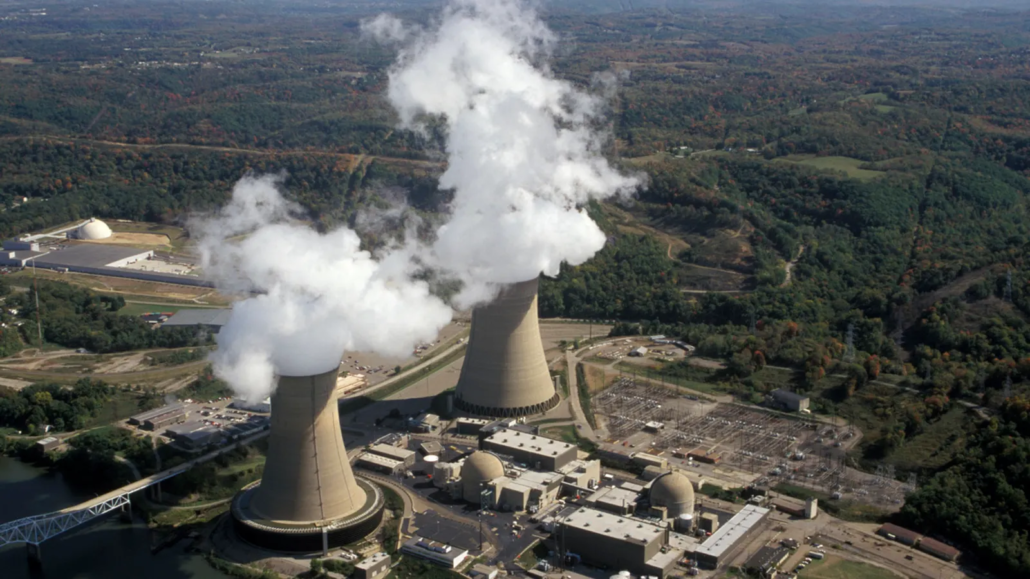
“Beaver Valley Nuclear Power Plant.” Retrieved from Wikipedia.
This opinion editorial was first published in Utility Dive on September 5, 2025. Find it here.
Amory B. Lovins teaches engineering at Stanford, and is cofounder and chairman emeritus of RMI.
An intensive influence campaign seeks to resurrect a “nuclear renaissance” from the industry’s slow-motion collapse documented in the independent annual World Nuclear Industry Status Report. Claims that past failures won’t recur have convinced many politicians that socializing nuclear investments rejected by private capital markets, weakening or bypassing rigorous safety regulation, suppressing market competition, and commanding military reactor and data-center projects as a national-security imperative will restore nuclear expansion and transform the economy.
This illusion neatly fits the industry’s business-model shift from selling products to harvesting subsidies.
A few awkward facts intrude. Even the most skilled firms and nations keep delivering big reactors with several times the promised cost and construction time. A swarm of startup firms that have never built a reactor are dubiously rebranding their inexperience as a winning advantage. New designs are said to be so safe they don’t need normal precautions (though not safe enough to waive nuclear energy’s unique exemption from accident liability). Political interference in nuclear licensing is eroding public confidence. Proposed smaller reactors cost more per kWh, produce more nuclear waste per kWh, and often need more-concentrated fuel directly usable for nuclear weapons.
And nuclear power faces the same fundamental challenges as fossil fuels: uncompetitive costs, runaway competitors, dwindling profits, and uncertain demand. Few if any vendors have made profits selling reactors — only fueling and fixing them. Nuclear electricity loses in open auctions, so only Congressional bailouts — $27 billion ($15 billion paid out) in 2005, $133 billion in 2021-22, tens of billions more in 2025 — saved most existing U.S. reactors from closure.
Now comes another vision: powering the glorious new world of artificial intelligence. This may be a trillion-dollar bubble, but it’s sellable until market realities intervene. The International Energy Agency expects data centers, mostly non-AI, to cause only a tenth of global electricity demand growth to 2030, doubling their share of usage — to just 3%. So AI won’t eat the grid. But IEA forecasts renewables will power data-center growth10-20 times over, while Bloomberg NEF predicts over 100. Nuclear lost the race to power the grid, so new reactors have no business case or operational need.
Each year, nuclear adds as much net global capacity as renewables add every two days. Soaring renewables generate three times more global electricity than stagnant nuclear power, whose 9% world and 18% U.S. shares keep shrinking. In 2023-24, China added 197 times more solar and wind than nuclear capacity, at half the cost. In May, China added 93 GW of solar, or 3 GW per day.
Despite having turned nuclear power into a minor distraction, renewables are dismissed as “intermittent.” Again, facts intrude.
Military and industrial installations already prefer 100% renewables for their most critical applications, including Apple’s data centers in four states. Ten kinds of carbon-free resources can balance variable (but highly predictable) renewables, keeping the grid stable. Using a small subset, power systems with modest or no hydropower already sustain such annual renewable fractions of electricity use as Denmark 88+%, South Australia 74% (expecting 100% in two years), and Germany 54%.
And since a nuclear kWh costs several to many times more than a renewable or saved kWh — even more if nuclear load-follows to “complement” rather than curtail renewables — nuclear displaces less fossil fuel per dollar (or year), making climate change worse.
Nonetheless, nuclear power is being boosted by fierce lobbying and federal policy as essential for new AI data centers vital for prosperity and security. This case can’t withstand scrutiny. My essay “Artificial Intelligence Meets Natural Stupidity: Managing the Risks” shows:
Data centers use about 4.5-5% of U.S. and 1.5% of world electricity, and lately caused only about 5% of world electricity demand growth. Of all data-center electricity, about one-fourth in the U.S. or one-ninth globally is for AI, the rest for traditional uses.
Claims of soaring AI electricity use are projections, not realities, except in a few “hot spots” like two Virginia counties. In 2023, AI added roughly 0.04% to world and 0.1% to U.S. electricity use.
Most proposed AI data centers are speculative and unlikely to get built; many built won’t thrive. Major power-supply investments risk getting stranded.
Demand for AI services is enormously uncertain. So is their business case: AI’s proven value in narrowly specialized technical applications looks too small to repay its immense investments. Many general users don’t need or want to pay for AI.
Big Tech firms rarely sign specific nuclear power purchase agreements. Much of the hype is about vague statements of interest in buying electricity timely at an attractive price, or modest, symbolic investments. Big Tech rightly prefers renewables as faster, surer and cheaper.
The efficiency of turning electricity into AI services roughly quadruples each year, so a new data center must roughly quadruple its sales of AI services each year for decades to keep using and paying for the same amount of electricity — a tall order.
This spring, innovators showed how operating AI data centers slightly more flexibly without compromising service can power at least the next decade of U.S. AI growth with no new generators, stranding more electricity and gas investments.
The coal industry’s 1999 campaign to create panic that the Internet would falter without huge power expansions misled investors, worsening a 2000-02 bloodbath when hundreds of new power plants weren’t needed. Today’s trends, pushing an AI case for unsellable and too-late nuclear and gas projects, rhyme with that disaster.
The latest risk to the AI/nuclear case came into focus in Sparks, Nevada, in June, when Redwood Energy (a new activity of dominant battery-recycler Redwood Materials) revealed North America’s largest microgrid.
Twenty MW-DC of photovoltaics are laid flat on level ground. Water-recovering Roomba-like crawlers clean them nightly. About 800 battery packs from retired or crashed cars — the world’s largest use of second-life batteries — are wrapped in white plastic and set on cinderblocks, safely separated. They’re good for another few years, then hot-swappable. Novel power electronics and software meld those diverse batteries into 63 MWh of storage with 2-48-hour nominal duration. (Redwood Energy is already engineering similar microgrids an order of magnitude larger, enough to run most existing data centers.)
The resulting 100%-solar microgrid produces 10 MW-AC of ultrareliable 24/7/365 power that runs modular Crusoe data centers onsite, eliminating transmission costs, losses and approvals. This all-solar power is more reliable than grid power, cheaper than the utility’s 8¢/kWh retail price, and allbuiltin four months.
Thus, we needn’t guess or debate whether a particular data center will get built and flourish. Instead, we can commit to build its onsite solar power plant, perhaps by competitive procurement, only when the data center’s 1.5 to 2.5 years of construction is mostly done. Needing no grid connection, the solar microgrid needs few if any approvals — just cheap land. It’s inherently safe, silent, automatic, virtually water- and maintenance-free, based on common commodities, zero-emission, portable and durably profitable.
Can your reactor do that? If not, why build it?
https://nuclearcosts.org/wp-content/uploads/2025/09/091125-Beaver_Valley_Nuclear_Power_Plant_YwfVn6S.webp9001600Web Masterhttps://hastingsgroupmedia.com/website_d72e85d9/wp-content/uploads/2025/05/Nuclearlogo340.svgWeb Master2025-09-19 10:00:002025-09-11 19:22:14Nuclear power is failing, and AI can’t rescue it
Over the past year, the federal government has doubled down on nuclear energy, initiating policies meant to fast-track “advanced” reactor deployment and prop up the domestic nuclear industry. Supporters call it a “nuclear renaissance,”but let’s be clear: this is not a beacon of progress. It’s a high-risk, high-cost gamble that threatens public health, safety, environmental justice, and our clean energy future.
Nuclear energy has always been riddled with false promises. These projects can take decades — if they’re ever completed at all — and typically come in far over budget. When reactors do come online, it is ratepayers who foot the bill through soaring electricity costs. Meanwhile, uranium extraction continues to devastate Indigenous lands, and the industry still has no viable long-term solution for the radioactive waste it creates. So why are we barreling down this dangerous path, when we have safer, faster, and far cheaper energy sources like wind, solar, geothermal and storage?
In the past year alone, the federal government has plowed ahead with a reckless pro-nuclear agenda, ignoring mounting concerns around cost, safety, and environmental harm. In July 2024, the Accelerating Deployment of Versatile, Advanced Nuclear for Clean Energy (ADVANCE) Act was signed into law, requiring the Nuclear Regulatory Commission (NRC) to “streamline its licensing process,” i.e. weakening its safety reviews. Alarmingly, the law even directs the NRC to revise its mission statement to prioritize efficiency and industry support over its foundational responsibility: protecting public health and safety.
On the campaign trail, Pres. Donald Trump acknowledged the risks of nuclear energy, citing its complexity, ballooning costs, and safety concerns. Yet since returning to office, he’s reversed course. In May, he signed four executive orders aimed at quadrupling U.S. nuclear capacity by 2050, adding 300 gigawatts of new capacity, and dismantling the NRC’s independence in the process.
Mandate expedited approvals for new reactor designs and licenses, limiting the NRC’s ability to conduct thorough safety reviews.
Shrink the NRC by reducing staff and reevaluating critical radiation safety standards.
Transfer greater authority to the Department of Energy (DOE) and Department of Defense (DOD), bypassing independent oversight. This includes directing DOE to approve three new reactor designs by July 2026.
Prioritize nuclear expansion as a tool for national security and powering energy-intensive industries like artificial intelligence data centers.
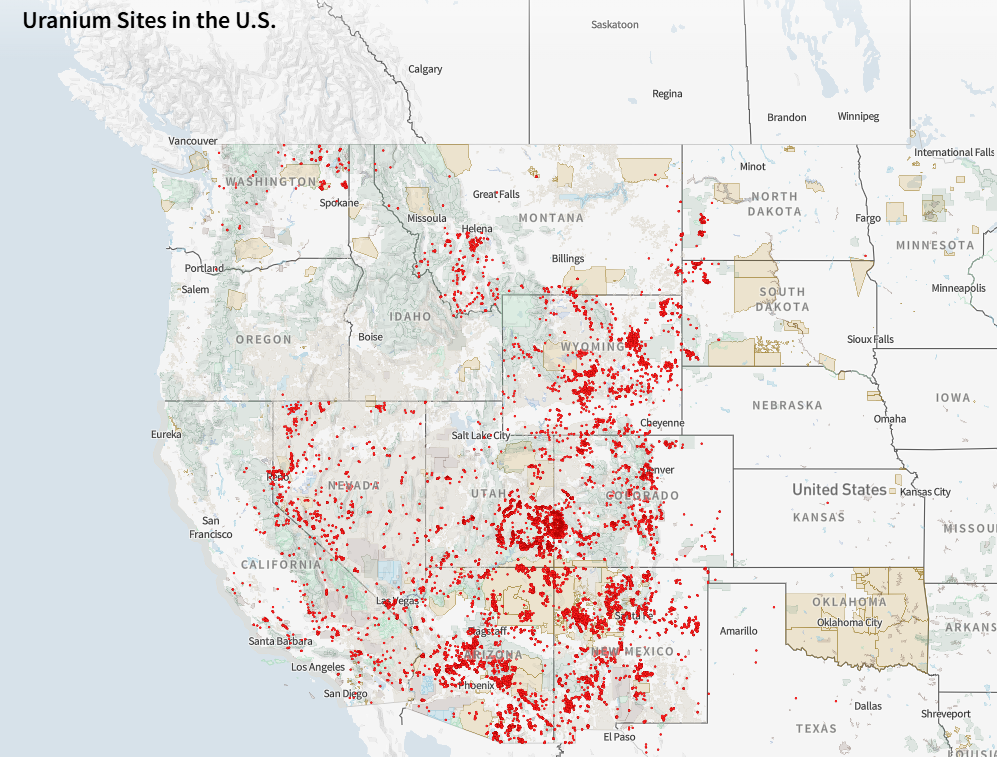
The common theme? Accelerate nuclear development at the expense of public safety, environmental review, and regulatory integrity. The consequences of this reckless agenda are already showing. Around the same time the executive orders were signed, the Department of the Interior approved a uranium mine in Utah after just 11 days of environmental review — a process that normally takes years due to the serious risks of uranium contamination. What could possibly go wrong?
The only new nuclear plant to come online in the U.S. in the past 30 years is Georgia’s Vogtle plant, completed at a staggering cost of $36.8 billion. Despite the hype, not a single small modular reactor (SMR) is operating in the U.S., and just three exist globally (one in Russia and two in China). The notion that the DOE will approve three entirely new reactor designs by next year and build 300 gigawatts of nuclear capacity over the next 25 years is nothing short of a dangerous pipe dream.
In June, Pres. Trump abruptly fired NRC Commissioner Chris Hanson, a move that raised alarms. The Union of Concerned Scientists called it a threat to the agency’s independence and its ability to ensure nuclear safety. Then in July, it came to light that a staffer from the Department of Government Efficiency (DOGE) who was assigned to the NRC told top officials in May that the NRC would be expected to “rubber stamp” reactors approved by the DOE or DOD. This effectively sidelines the NRC’s ability to independently assess the safety of new reactor designs. These moves, taken together, represent the most aggressive political interference in the NRC since its founding. They threaten to transform what should be a watchdog agency into a lapdog, paving the way for risky, untested nuclear technologies to be rushed onto the grid with minimal oversight.
Then, at the end of July, another commissioner at the NRC, Annie Caputo, announced her resignation as the Trump Administration escalates efforts to streamline nuclear energy rules and reduce the agency’s independence. Caputo, known for her industry-friendly stance, cited a desire to focus on family, but her departure raises concerns about deeper political shifts at the NRC.
This isn’t just a bureaucratic battle; it’s about public health, safety, environmental justice, and our future. Nuclear energy is not necessary to meet our climate goals. Clean, affordable, and proven technologies like wind, solar, geothermal and storage are already here. What we need is the political will to invest in them, not to pour billions into a failed industry with a dangerous track record.
Shannon James is the Campaigns & Advocacy Director at the Montana Environmental Information Center.
https://nuclearcosts.org/wp-content/uploads/2025/09/Construction_at_Vogtle_Nuclear_Plant-scaled.jpg19112560Web Masterhttps://hastingsgroupmedia.com/website_d72e85d9/wp-content/uploads/2025/05/Nuclearlogo340.svgWeb Master2025-09-05 10:00:002025-10-08 11:12:10A “Nuclear Renaissance” Built on False Promises and Growing Risks
Republished with permission from SACE, find original article here.
TVA and the Trump Administration are rushing new nuclear power plant technologies that are unproven and not cost effective while weakening the regulatory framework designed to review cost and safety
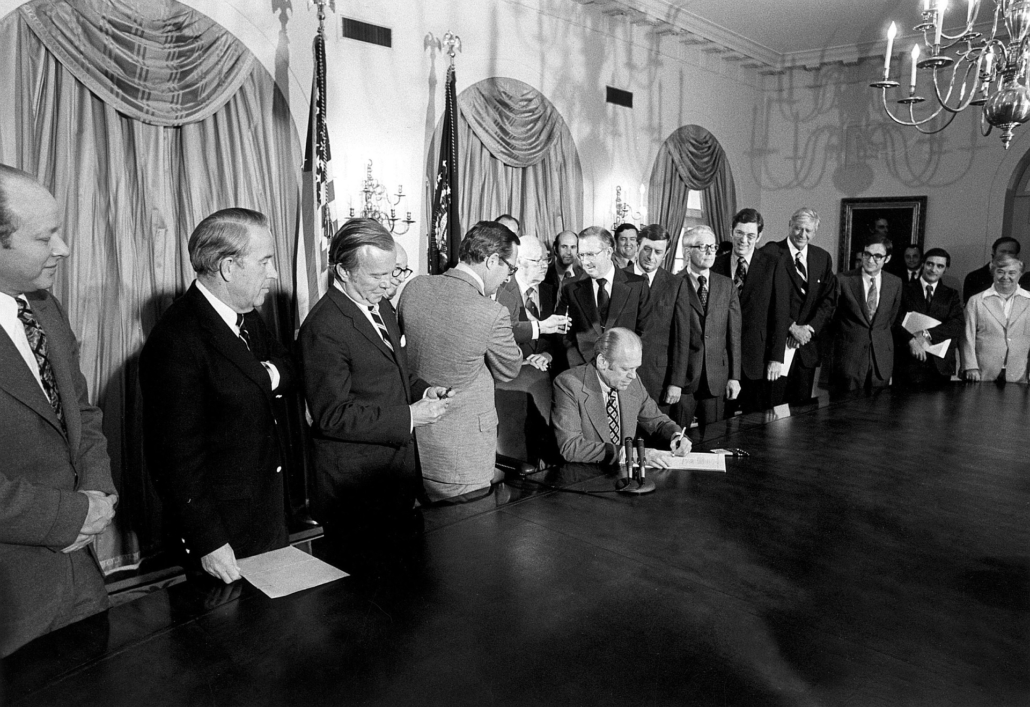
President Ford signing the Energy Reorganization Act, which created the Nuclear Regulatory Commission.
Forgetting History While Ignoring Cost and Safety
This past week we saw a flurry of rushed decisions around nuclear power, first with TVA submitting a construction permit for their GE-Hitachi BWRX-300 Small Modular Reactor design near Oak Ridge, Tennessee followed late Friday afternoon, May 23, 2025 with four Trump Executive Orders apparently attempting to restructure the regulatory framework of nuclear power oversight and accelerating deployment of more unproven nuclear power designs. We have known that TVA was exploring the SMR technology, but had understood it was not cost-effective and that a decision to move forward had not been made; this action would indicate otherwise.
The Executive Orders raise more questions than they answer, but appear to push the Nuclear Regulatory Commission (NRC) to short-circuit their safety and review process and even allow the Department of Energy (DOE) and Department of Defense (DOD) to rush forward with nuclear power plants outside of the regulatory process. Congress separated the Atomic Energy Commission (AEC) in 1974 with the Energy Reorganization Act, signed into law by President Ford, which created the Nuclear Regulatory Commission (NRC) to handle nuclear safety regulation. The Department of Energy (DOE) was created later in 1977 through the Department of Energy Organization Act, which took over the AEC’s nuclear weapons and energy development functions along with energy programs from other agencies.
The separation was designed to address conflicts of interest that had developed within the AEC, which had been both promoting nuclear technology and regulating its safety since 1946. The 1974 reorganization split these functions, giving the NRC independent regulatory authority over civilian nuclear power while transferring the promotional and weapons-related activities to what would become the DOE.
Executive Order Concerns
According to Peter Behr’s Politico Energy Wire story, former nuclear regulators and industry experts are raising serious alarms about Trump’s executive orders potentially undermining decades of independent nuclear safety oversight. Former NRC chairs Allison Macfarlane and Stephen Burns warn that political interference in the historically independent Nuclear Regulatory Commission will “crater” essential public confidence in nuclear power and damage public trust. The orders mandate staff reductions at the NRC while simultaneously requiring the agency to complete a “wholesale revision” of safety regulations within months, leading Senator Ed Markey to warn that “it will be impossible for NRC to maintain a commitment to safety and oversight with staffing levels slashed and expertise gone.”
Technical Challenges Remain Complex
The advanced reactor technologies that Trump is counting on for his nuclear “renaissance” present unprecedented safety review challenges that cannot be rushed without significant risk. According to a 2023 National Academies study, most advanced reactors use unfamiliar cooling systems like liquid sodium, helium gas, or molten salt instead of traditional water cooling, requiring extensive testing and safety analysis. Former NRC Chair Richard Meserve emphasized that “there is no way to cut corners on ensuring that these new features are carefully analyzed,” while industry veteran Amir Afzali noted that sodium-cooled reactors face “significant fire risk, as sodium ignites explosively on contact with air,” requiring rigorous testing and monitoring that increases costs.
Will We Ever Learn
Critics point to recent nuclear project failures as evidence that regulatory shortcuts won’t solve the industry’s fundamental cost problems. The Georgia Power Vogtle expansion, which used NRC-approved reactor designs, still ended up costing $35 billion and running seven years late — problems that stemmed from construction and financing issues rather than regulatory delays. As Afzali observed, “the NRC can’t be blamed for the issues Vogtle faced,” and history across industries shows that “weakening oversight and blurring the lines between promotion and regulation” leads to “serious consequences.” The orders risk repeating past mistakes by prioritizing speed over safety in an industry where public trust and technical precision are paramount. Proponents of nuclear power have concerns that the Executive Orders may be illegal and increase uncertainty and delays.
Small Modular Reactors: Big Promises, Bigger Price Tags
This dream has been hyped by many Tennessee politicians and the Oak Ridge community who have never met a nuclear project they did not like. As with many dreams they can take a turn for the worse when not grounded in reality. The missing reality in this dream, as with so many nuclear proponents’ dreams, is price and schedule. TVA’s C-suite executives dreams can easily become Tennessee Valley ratepayers’ worst nightmare when fuzzy math and hype prevail over facts and prudence. Below are the facts that beg for more prudence.
A Small Modular Reactor along the Clinch River. Source: TVA
BWRX-300 and other SMRs pose significant financial risks to ratepayers
In the race to decarbonize our electricity system, small modular reactors (SMRs) have been touted as the nuclear industry’s silver bullet – smaller, faster to build, and more affordable than their larger predecessors. Among the leading designs is GE Hitachi’s BWRX-300, which has attracted interest from utilities across North America. But recent expert testimony before the Colorado Public Utilities Commission by energy analyst David Schlissel raises serious questions about whether these reactors can deliver on their promises or will instead burden ratepayers with massive costs.
The rising price tag of the BWRX-300
While GE Hitachi has kept many of the BWRX-300’s financial details under wraps, what we do know is concerning. According to Schlissel’s testimony, TVA’s recent filings reveal an estimated overnight cost for the BWRX-300 of $17,949 per kilowatt in 2024 dollars. This figure only covers the base construction costs – it doesn’t include financing costs or inflation during the years of construction.
When all costs are factored in, the final price per kilowatt will be substantially higher. For comparison, that base cost is already nearly twice as high as what GE Hitachi initially suggested the reactor might cost.
“The estimated all-in cost of the project must be much higher than shown,” Schlissel testified, noting that overnight costs exclude escalation and financing costs that typically add substantial amounts to nuclear projects.
The pattern of ballooning costs
The BWRX-300 isn’t unique in facing cost increases. Every SMR design on the market has seen dramatic cost escalation before a single reactor has been built in the United States:
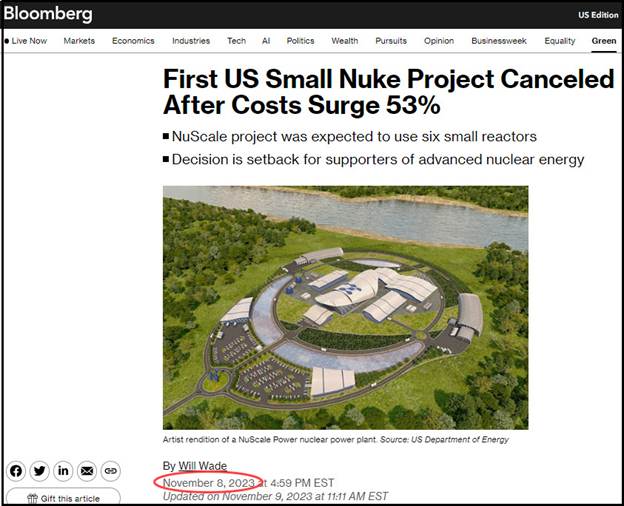
NuScale’s SMR project saw costs nearly triple from $6,833/kW in 2015 to $20,130/kW by 2023 before being canceled
X-Energy’s reactor cost estimates jumped 72% in just three years (2021-2024)
TerraPower’s Natrium reactor, initially touted as potentially costing $11,594/kW, is now estimated at $28,986/kW according to recent admissions by Bill Gates, the company’s founder
“It is extremely likely that any future SMRs or large reactors will cost far more and take far longer to build than the nuclear industry and its supporters now claim,” Schlissel concluded. “That has been the long history of nuclear power in the United States, and I see no evidence that leads me to believe it will change anytime in the foreseeable future.”
The international experience is no better
Supporters of the BWRX-300 and other SMR designs often suggest we should ignore the U.S. nuclear industry’s troubled history of cost overruns. But the international experience with SMRs tells the same story:
China’s Shidao Bay SMR cost tripled from its original estimate
Russia’s floating SMRs saw costs quadruple
Argentina’s CAREM 25 SMR has had cost increases of over 600% and is still under construction
Just as troubling, these projects all faced years-long schedule delays. China’s SMR took 11 years instead of 4 to complete, while Russia’s took 13 years instead of 3. Argentina’s is still under construction after 10 years, with at least 3 more years to go.
For the BWRX-300, which has yet to begin construction anywhere, these patterns suggest ratepayers should be extremely skeptical of current cost and schedule projections.
Factory fabrication: An empty promise?
A central claim made about the BWRX-300 and other SMRs is that they will be less expensive because modules will be manufactured in factories and assembled on site. However, as Schlissel points out, none of the SMR vendors marketing designs in the U.S. currently have factories where their reactor modules are being built.
“One of the key claims by supporters of SMRs is that the reactors will be less expensive to build because key reactor modules will be manufactured in factories and assembled on site. Yet, to my knowledge, no SMR vendor has yet opened a single factory,” Schlissel testified.
This same promise was made for the AP1000 reactors built at Georgia’s Plant Vogtle, which were supposed to utilize modular construction techniques to reduce costs and construction time. Instead, the project experienced a 157% cost overrun and a 6 to 7 year schedule delay – hardly a promising precedent for the BWRX-300.
No evidence of a learning curve
GE Hitachi and other SMR vendors claim that building multiple copies of the same design will lead to cost declines over time. But Schlissel’s analysis found no evidence of such a “positive learning curve” in nuclear construction:
“Even the French nuclear program, which relied on a high degree of standardization in the design of its 58 reactors built between 1974 and 1990, failed to achieve a positive learning curve. Instead, costs continued to increase over time despite the program’s design standardization.”
His analysis of construction schedules for recent reactor designs shows no meaningful reduction in construction time for subsequent builds of the same design.
Still too expensive, even with subsidies
Even with the Inflation Reduction Act’s generous 50% Investment Tax Credit for new nuclear plants built in communities that have had now-retired fossil plants, Schlissel’s analysis found that the cost of electricity from SMRs like the BWRX-300 would still be far higher than renewable alternatives.
Using NREL’s Annual Technical Baseline data, Schlissel demonstrated that SMR power would cost $115-251/MWh in 2035, compared to much lower costs for wind, solar PV, and storage. It’s worth noting that while tax credits reduce costs to ratepayers, they simply shift the burden to taxpayers – who are the very same people.
Too slow to address climate change
The climate crisis demands rapid action. Yet even by optimistic projections, the first BWRX-300 won’t be operational until the 2030s. Given the patterns of delay seen in every nuclear project to date, the timeline could easily stretch into the 2040s.
Meanwhile, renewable energy and storage systems can be deployed in months or a few years, making them far more effective tools for near-term carbon reduction.
The flexibility factor
Perhaps most concerning for ratepayers is that investing in expensive nuclear projects like the BWRX-300 locks utilities into very long-term financial commitments when future electricity demand is uncertain. If the dramatic increases in demand currently forecast don’t materialize, or if they materialize differently than expected, ratepayers could be stuck paying for expensive overcapacity.
As Schlissel notes: “A renewable energy park would give the Company valuable flexibility in its resource planning… New resources could be added in a relatively shorter number of years if demand grows at a higher rate than now expected. This flexibility is vital in today’s dynamic energy transition.”
Conclusion: A risky bet for ratepayers
The BWRX-300 and other SMRs represent a massive financial gamble for utilities and their ratepayers. While the technology sounds promising, the evidence suggests these reactors will follow the same pattern of massive cost overruns and delays that have plagued nuclear projects for decades.
Before committing billions of ratepayer dollars to these unproven technologies, utilities and regulators should carefully consider the overwhelming evidence that SMRs like the BWRX-300 are unlikely to deliver on their promises of affordable, timely carbon-free power.
As expert David Schlissel recommends, a more prudent approach would be to invest in proven renewable energy and battery storage technologies that can be deployed quickly, scaled flexibly, and have consistently demonstrated falling costs over time.
This blog post is based on expert testimony by David A. Schlissel before the Colorado Public Utilities Commission in April 2025, as part of Proceeding No. 24A-0442E concerning Public Service Company of Colorado’s application for approval of its 2024 Just Transition Solicitation.
https://nuclearcosts.org/wp-content/uploads/2025/08/082225_PresFord_1920width.jpg13181920VBELTRANhttps://hastingsgroupmedia.com/website_d72e85d9/wp-content/uploads/2025/05/Nuclearlogo340.svgVBELTRAN2025-08-22 10:00:002025-08-22 13:48:01Rush to Build New Nuclear Power: TVA and Administration Ignore Cost and Safety
How federal incentives created Plant Vogtle’s $36 billion disaster—and now threaten to repeat history.
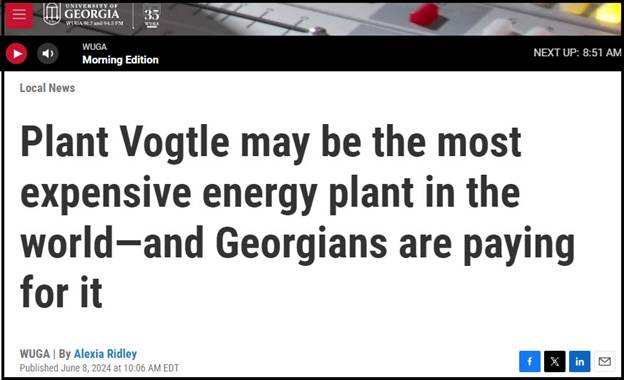
In May 2024, Georgia Power marked the completion of two new nuclear reactors at Plant Vogtle, the first reactors built in the United States in over three decades. Rather than a moment of triumph, the project has become a stark symbol of misplaced priorities, government overreach, and utility profiteering. With a final price tag of $36 billion—more than $20 billion over budget—and a timeline that stretched seven years beyond the original schedule, Plant Vogtle is now the most expensive power plant ever built on Earth. For Georgia ratepayers, this is not an abstract financial disaster—it’s one they are paying for directly, and will be for decades to come.
The scale of Vogtle’s impact on Georgia consumers is unprecedented. Long before a single watt of electricity flowed from the new reactors, residential customers had already paid approximately $1,000 each through early financing charges—effectively subsidizing the construction before the reactors were finished with no guarantee of performance or accountability. Once the two nuclear reactors (Units 3 & 4) went online, customers saw a jarring 23.7% increase in their electric bills. This was in stark contrast to repeated assurances over the years that rate increases would be modest, falling in the range of 2–3%. The actual outcome was nearly ten times that, a betrayal of public trust that raises serious questions about regulatory oversight and utility transparency.
The only reason Vogtle’s expansion happened at all is because of the Energy Policy Act of 2005. This law, passed in the wake of renewed interest in carbon free electricity, offered federal incentives that distorted market realities. It included generous loan guarantees, production tax credits, and federally backed insurance (known as the Price Anderson Act, recently extended for another 40 years) because private insurance will not touch nuclear power with its catastrophic meltdown risks. These federal incentives made nuclear power development palatable to utilities and investors who otherwise would avoid high risk ventures. In Vogtle’s case, the project was supported with a staggering $12 billion in Department of Energy (DOE) loans. Without these taxpayer-backed subsidies, no private investor or utility would have dared to take on a project of this magnitude.
Now, twenty years after the passage of the 2005 law, the same false claims of “this time will be different” are being repeated. Instead of learning from Plant Vogtle’s delays, budget overruns, and the financial burden placed on everyday Georgians, federal leaders have chosen to double down. On July 4, 2025, Congress passed the latest tax package supported by the Trump administration, including provisions that once again favor nuclear power development over actual affordable, proven energy technologies such as wind, solar, and energy efficiency, with lucrative tax breaks and faster permitting processes.
But the poor economics of new nuclear power have not changed. It remains one of the most expensive and slowest forms of energy generation to bring online. It requires decades of upfront investment, all while cheap, fast, clean and safe alternatives—like wind, solar, and battery storage—continue to fall in price and improve in reliability.
Nuclear proponents pin their hopes on “small modular reactors” (SMRs) and “next generation” so-called “advanced” designs which promise to be different, similar to promises that were made for new nuclear leading up to passage of 2005 Energy Policy Act: “modular designs” and “streamlined permitting”. There was nothing different then and there’s nothing different now: Projects like the failed NuScale/UAMPs reactors in Idaho to power Utah communities had costs skyrocket and timelines slip, just like traditional reactors. SMRs not only bring no cost savings, but they introduce new problems of nuclear waste scattered across the country and increased security risks at every site. It’s the same old nuclear issues—just multiplied and repackaged with much more hype.
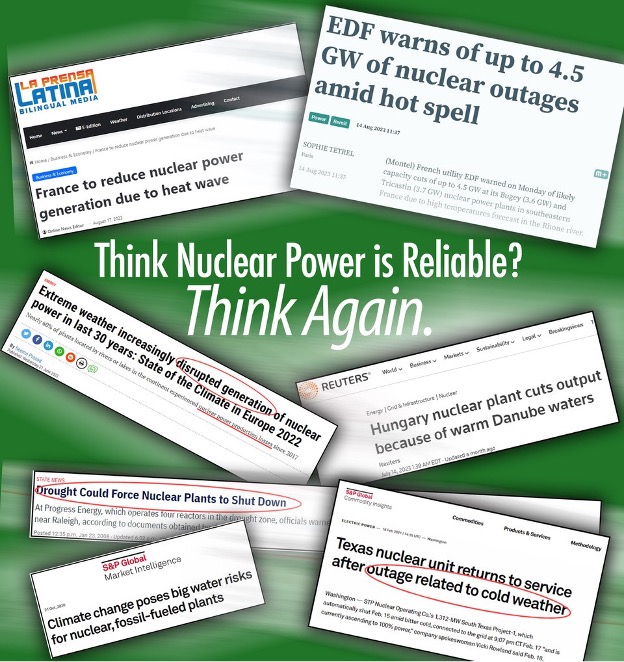
Meanwhile, the climate clock is ticking: 2024 was the hottest year in recorded history. If the goal is to reduce CO2 emissions quickly, nuclear power is simply too slow. Plant Vogtle’s two reactors (just over 2000 Megawatts) took 15 years from initial planning to completion. We cannot wait that long for solutions. Even worse, there have been no studies on the reliability of nuclear power plants to withstand extreme weather due to climate change. Early indications are that nuclear power is not reliable during droughts, heat waves, and arctic blasts.
Finally, the enormous financial resources tied up in nuclear projects could be deployed much more effectively in renewable energy, grid modernization, efficiency programs, and climate resilience. Instead, policymakers block affordable rooftop solar at the urging of monopoly utilities and pour public taxpayer funds into nuclear projects that offer no short-term emissions benefits and very real long-term financial risks. Socialize the risk, privatize the profits.
And what of the ratepayers? They bear the cost without a say. They are the ones who see their monthly bills go up while utility shareholders reap guaranteed profits from state-approved construction work in progress (CWIP) charges and other rate mechanisms. In Georgia, this model has led to a perverse outcome: failure is rewarded, and success—delivering affordable, clean energy on time and on budget—is not incentivized.
New nuclear power is not helping ratepayers, and it’s not helping the climate. It is a high-stakes gamble that delays real action and burdens communities with unmanageable costs. The Plant Vogtle debacle is a cautionary tale – a model for how bad policy, corporate influence, and regulatory negligence can distort our energy future. Unfortunately, too many people, including federal lawmakers, failed to learn from these mistakes and have been fooled by the nuclear industry and its proponents once again. If we continue down this path, it won’t just be Georgians that pays the price—it will be all of us.
Patty Durand is the director of Georgians for Affordable Energy, a nonprofit organization that seeks utility reform in Georgia. Patty has an energy background and ran for a seat on the Georgia Public Service Commission in 2022.
https://nuclearcosts.org/wp-content/uploads/2024/08/072925_2005_Energy_Policy_Act.jpg343515VBELTRANhttps://hastingsgroupmedia.com/website_d72e85d9/wp-content/uploads/2025/05/Nuclearlogo340.svgVBELTRAN2025-08-08 09:00:002025-08-01 20:10:05Two Decades of Nuclear Hype & No Lessons Learned: The Energy Policy Act Turns 20