Nuclear Fallout at the Georgia Public Service Commission 2.0
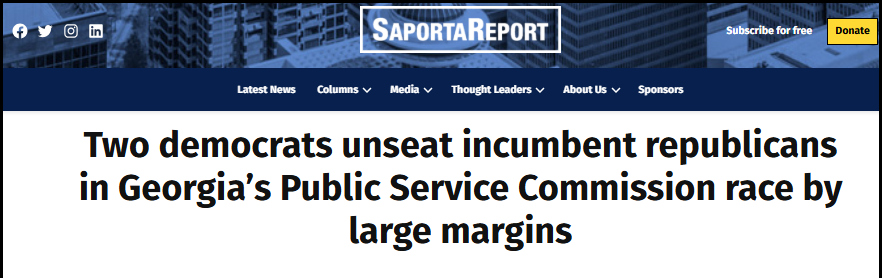
In Georgia, the political fallout from nuclear power is no longer theoretical—it is electoral. On May 19, 2024, state officials enjoyed cake in the shape of nuclear reactors at the Plant Vogtle ribbon cutting in Waynesboro to celebrate the completion of the first two nuclear reactors built in the United States in 30 years. Just 18 months later, two of those pro-nuclear regulators, Commissioners Tim Echols and Fitz Johnson, were gone, ejected in landslide numbers by voters who did not like the huge utility bills that followed. Six months later, a third pro-nuclear regular, Commissioner Trisha Pridemore, announced that she would not run for reelection.
This fallout was of their own making: Plant Vogtle’s total cost of $36 billion marks it as the most expensive power plant ever built on earth. The project went $17 billion over budget and was delivered seven years late. Yet Georgia’s pro-utility regulators had only positive things to say throughout construction, then voted to make customers reimburse Georgia Power for nearly all of Vogtle’s cost overruns while granting them profits far above industry norms. Allowing billions in cost overruns to flow directly into customer bills raised rates a stunning 25%, the largest rate increase in state history, one that will last across the 60-year depreciation schedule for the reactors.
This harmful financial outcome for customers was predictable. Many nuclear energy experts, as well as commission staff, testified both before the project began in 2008 and again in 2017—after massive overruns drove main contractor Westinghouse Electric Company into bankruptcy—that the project should be scrapped. The financial risks for Georgians were too high, they said, and less expensive generation was available. Public opposition was strong too. All were ignored by regulators who voted to continue.
Meanwhile, as Georgia Power customers experienced high bills, Georgia Power received record profits. The contrast is stark: while customers experience utility bills the size of car payments, in 2024 Georgia Power enjoyed record profits of $2.5 billion, and in 2025 profits were a stunning $2.85 billion. These profits are far higher than a monopoly market delivering an essential commodity, electrons, should earn, and would not earn without state protectionism.
What comes with high utility bills? High customer disconnections. In 2025, Georgia Power disconnected approximately 275,000 customers, or one in nine Georgia Power households compared to a national average of only 1%.
The irony is striking: Georgia’s state officials celebrate grid reliability while overlooking a fundamental reality—electricity is not reliable for customers who cannot afford it. Even setting aside that Georgia Power’s reliability metrics fall below the national average, when a household is disconnected the grid is no longer reliable for the people it is meant to serve.
The political consequences are now spreading beyond Georgia. Lawmakers in Alabama are advancing proposals to eliminate elections for the Alabama Public Service Commission after watching Georgia voters elect two Democrats from their regulatory body following Vogtle-related rate increases. So rather than adjust energy policy to reduce consumer risk, policymakers seek to reduce voter oversight instead.

Georgia’s experience demonstrates that when nuclear construction drives electricity prices sharply upward, voters hold regulators accountable. If elections are weakened or eliminated in response to nuclear-driven rate backlash, it signals that policymakers understand the financial risks but prefer to shield regulators from consequences rather than protect customers.
Despite the first nuclear reactor construction project in 30 years going off the rails, several states are now exploring nuclear construction using the same AP1000 reactor design that Georgia Power used. Policymakers in New York, Texas, South Carolina, and Pennsylvania have all discussed, or initiated, pathways for advanced or large-scale nuclear expansion involving Westinghouse technologies.
The discussion is particularly notable in South Carolina given the state’s similar nuclear construction project to Georgia’s. In 2017 that state ended its V.C. Summer nuclear project given that cost overruns had already raised bills nine times with no end in sight. Some South Carolina regulators and Westinghouse officials went to jail or paid hundreds of millions in fines for lying about cost estimates and construction progress.
The job of a commissioner is to balance utility financial viability with affordable bills, but instead Georgia’s regulators allowed costs that ballooned from construction delays, contractor failures, and project mismanagement to be transferred to Georgia Power customers. Georgia regulators thought voters wouldn’t see past their infrastructure promises while they ignored utility bill affordability, but electricity is not a luxury. It is a necessity. When bills rise but profits soar for the utility, voters correctly interpret the situation and move to end the political careers for those driving it.
Georgia’s experience should serve as a warning to those now pursuing nuclear power, few of whom understand what happened in Georgia. When nuclear construction costs spiral – and they always do because nuclear construction is the only generation type that does not go down in cost over time – voters rightfully hold regulators responsible for the surge in electricity bills. Regulators will not be thanked for building nuclear power. They will be removed.
Nuclear fallout reshaped Georgia’s political landscape, propelling two Democrats onto the state’s utility regulatory commission and prompting a third to drop out.
The lesson is clear: costly energy decisions do not remain confined to regulatory dockets—they are judged at the ballot box. State officials who fail to protect consumers will be replaced.
Byline: Patty Durand is the founder of Georgians for Affordable Energy, a nonprofit that advocates for fair utility rates and responsible energy policy in Georgia.