Republished with permission from Beyond Nuclear, find original article here.
Are the nuclear startups burying themselves in a deep money pit, asks Linda Pentz Gunter
“Pushing dirt around in an Idaho field,” was the delightful comment left at the end of Iceberg Research’s most recent and damning report about the financial prospects for the multiple nuclear reactor startup companies all vying for customers none of them actually have in what Iceberg calls an “increasingly crowded market.”
The Iceberg analysis was focused on the Berkeley California-based reactor ingenue company, Deep Fission, and its brassy boasts that don’t seem to quite match any actual reality. The September 24, 2026 report’s deliciously punny headline ran: “Deep Fission ($FISN): a Money Pit.” Deep Fission is the company proposing to establish micro-reactors in Parsons, Kansas, dropped into mile-deep boreholes. A citizens’ group called Prairie Dog Alliance — named after local wildlife that is quite adapt at digging deep tunnels itself — has sprung up to oppose the project.
The comment at the end, made by reader Tony Alton, wondered whether another reactor startup, Oklo, and its fairy tale-named Aurora reactor, which will likely remain imaginary, wasn’t an even better company to expose for its overblown hype.
“Excellent report, but surely OKLO is a similar but much larger target ($7B) whose officers are selling large amounts of their personal holdings on a monthly basis,” he wrote. “They have made no apparent progress toward licensing and their construction photos show a dozen pieces of heavy equipment pushing dirt around in an Idaho field.”
The field in question is at the Idaho National Laboratory, but even having that government imprimatur does not seem to have helped Oklo’s fortunes.
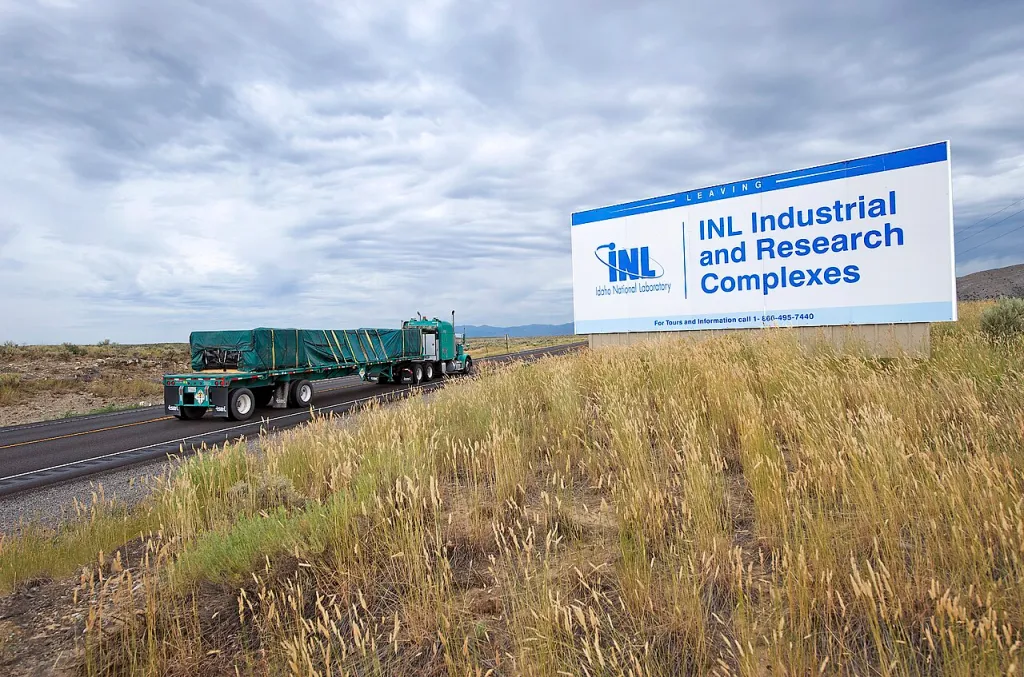
Oklo is currently “pushing dirt around” at Idaho National Lab but does not look to be gaining customers or income. (Photo of INL access point, ENERGY.gov/Wikimedia Commons)
The Iceberg report was largely dismissive of Deep Fission’s prospects, saying it would “not be a winner” and wondering whether its debacle on the stock market, where its stocks plummeted almost 11 percent within days, wasn’t just “a late attempt to ride the SMR hype, and dump a stranded asset onto retail investors.”
Around June 18 of this year Deep Fission conducted its initial public offering, known as an IPO, selling 2.5 million shares of stock at $16.00 per share. Then, on September 26, after Iceberg Research released its damning report, describing Deep Fission’s mile-deep borehole reactor technology as overhyped and unlikely to achieve commercial viability, Deep Fission’s stock price fell almost 11 percent, to close at $6.95 per share. By late October, the stocks had plummeted further, decreasing by 56.79% in the space of a month, and closing on October 22 at just $2.30 per share.
The Iceberg report also included some graphs, including one on the fate of the nine other reactor startups that have ventured onto the stock market so far. The graph rather resembles a multi-colored version of Donald Trump’s signature, that is, a lot of scribbling and vertical lines that are mainly headed downward. That trajectory is important and it’s the same for nuclear power as a whole worldwide. There may be some upward blips here and there, but over the long-term it’s a long, slippery downward slope into that money pit abyss, as the Iceberg Research headline warned.
As for Deep Fission, things are looking bleaker by the week. At least five law firms so far are conducting investigations on behalf of alarmed Deep Fission stockholders, exploring whether Deep Fission has engaged in securities fraud because it surely knew the flimsy basis on which its bold claims of success were made.
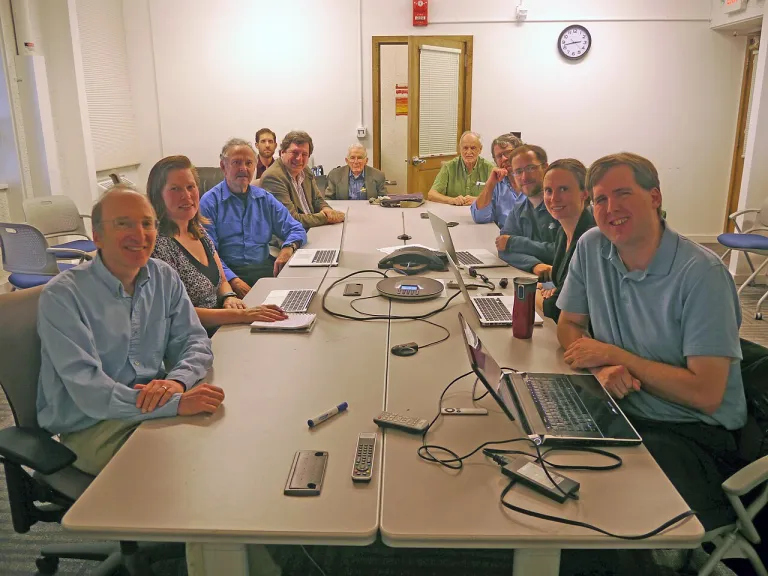
Richard Muller, third from left, and Elizabeth Muller, second from right, with the Berkeley Earth team in 2010. (Photo: Berkeley Earth/Wikimedia Commons)
They have good reason to be nervous, because this isn’t the first venture into the nuclear realm for Deep Fission’s father-daughter founders, Richard Muller and Elizabeth Muller. Ten years ago they launched a nuclear waste technology project, Deep Isolation. As Iceberg noted, that venture is “a deep-borehole nuclear waste disposal company that has failed to commercialize its concept after a decade.” The pair also founded something called Berkeley Earth in 2010 (see photo above.)
Deep Fission, Iceberg concluded, is “largely a repackaging” of the company’s non-starter Deep Isolation.
The nine companies, including Oklo and Deep Fission, that have already gone public, may have been rolling the dice when they first ventured onto the market, but now it looks more like tumbling dice. And their fellow gamblers — that is their investors — are starting to get restless if not downright mad.
There’s precedent here, of course. The country’s so-called flagship SMR company, NuScale, is still facing an on-going class action lawsuit for defrauding its investors after its original SMR project collapsed in 2023, after 16 years and no product. It is also facing potential lawsuits against its officers and/or directors and whether or not they may have engaged in securities fraud or other unlawful business practices.
At least one small modular reactor startup, Holtec — better known for nuclear waste interim storage and reactor decommissioning, even as it endeavors to restart the Palisades, Michigan reactor while also venturing into the SMR field — got the jitters and has withdrawn its IPO for now.
And there could be yet more legal trouble ahead for the 11 reactor projects that have been taken under the auspices of the Department of Energy — all the better to avoid the scrutiny of the Nuclear Regulatory Commission, which at least knows something about nuclear safety; and all the better to avoid any public intervention or the need to conduct environmental reviews, even though this is a violation of federal law under the National Environmental Policy Act, another piece of legislation the Trump administration is trying to destroy.
Fourteen States Attorneys General — plus Harris County, Texas and the District of Columbia— sent a letter to the NRC last August objecting to its rulemaking, ironically entitled Implementation of the National Environmental Policy Act, since that appears to be the opposite of what the NRC is planning to do. The NRC rulemaking instead proposes to make its NEPA implementing regulations less thorough, thereby reducing public confidence in the safety and security of the nuclear sector.
Among other things, the rule would potentially eliminate or at least limit opportunities for public engagement and intervention, doing away with a long tradition of public comment periods during environmental review for nuclear projects.
In keeping with the Trump executive orders to “unleash” and fast track new nuclear projects in the US, the NRC proposed rule would also allow the agency to rush through new nuclear projects without evaluating foreseeable environmental and climate change impacts.
All of this appears to violate statutory obligations under NEPA as required by the Administrative Procedure Act. Accordingly, the Attorneys General urged the NRC to rescind its rulemaking.
So far the NRC, now presumably stripped of most people of conscience thanks to Elon Musk’s early horror movie rampage with his metaphorical chainsaw, has ignored them and is pressing ahead.
Headline photo of the New York Stock Exchange by TomasEE/Wikimedia Commons.
Linda Pentz Gunter is the Executive Director of Beyond Nuclear and writes for and edits Beyond Nuclear International. She is the author of the book, No To Nuclear. Why Nuclear Power Destroys Lives, Derails Climate Progress And Provokes War, published by Pluto Press. Any opinions are her own.