Archive for year: 2026
Inherent Danger, Unaffordable Power. Capitol Hill presentation by Diane Curran.
Inherent Danger, Unaffordable Power. Capitol Hill presentation by Peter Bradford.
By Linda Pentz Gunter
The Trump administration is once again doing what it does best – demonstrating a complete disregard for the law, and we’re not even talking end runs around the IRS here, or slush funds with which to reward family members and violent insurrectionists.
This time, it’s about nuclear power and the latest rush by the White House to build new reactors in the US, whilst shortcutting its way around expensive annoyances such as safety regulations.
This eagerness to expand nuclear energy comes despite the fact that the new “advanced” or “small” reactor designs are too slow to get here for climate mitigation purposes, too expensive to make any sense when renewable energy can be deployed faster and more cheaply, and haven’t passed even the most rudimentary of safety evaluations. Almost every design proffered — and there are dozens of them — remain largely sketches on paper with unsolved technical challenges.
And yet, the country’s longstanding regulator, the US Nuclear Regulatory Commission (NRC), despite being stripped of a large part of its authority by the metaphorically axe-wielding Department OF Government Efficiency (DOGE), the murky entity created by the now departed Elon Musk and which may, or may not, still exist, is seemingly bending to every White House whim.
As a result, a so-called “Rubber-Stamp Rule” issued by the NRC is gaining momentum, even though it clearly violates key components of the Atomic Energy Act (AEA) and Energy Reorganization Act, according to comments filed recently by 13 organizations from across the US.
The proposed regulation, entitled “NRC Reviews of Reactor Designs Previously Authorized by U.S. Department of Energy or Department of War”, proposes to revise existing NRC regulations to facilitate direct leveraging that will allow reactor designs that the Department of Energy (DOE) and Department of Defense (DOD) have approved to bypass required safety reviews by the NRC.
The DOE has also announced that “pilot reactors” would be excluded from both NRC licensing and environmental reviews and that it would exempt previously untested reactors that it approves to be built and operated from any review of their environmental impacts.
The AEA gives the NRC sole authority and responsibility for the licensing of commercial reactors. The Proposed Rule would violate the AEA by allowing the NRC to accept safety findings from other agencies without verifying whether they are correct, compliant with the adequate protection standard, or adequately supported.
Accordingly, the Proposed Rule would create a kind of regulatory tunnel around NRC’s established regulations and statutorily required oversight and licensing processes. This would allow for DOE’s promotional biases and incorrect conclusions about reactor safety and environmental impacts to become the new normal in the regulation of the civilian nuclear power industry, exposing the public to unacceptable dangers to our health and safety.
Eleven state attorneys general, in their own March 11 comment filing, had earlier agreed with civil society groups that such exclusions violate existing law. The AGs concurred that the NRC, not the DOE, has licensing authority over the commercial reactor demonstration projects that the DOE undertakes.
The NRC’s proposed regulation would allow companies that want to build a nuclear reactor of the same design as one DOE has previously approved to merely submit documentation of that approval and claim that the previously built reactor is “safe.” Yet, the NRC rulemaking notice contains no explanation of what “safe” actually means.
New reactor companies would therefore likely never have to go through a detailed safety review by the NRC to build and operate such reactors. In 1974, Congress amended the Atomic Energy Act to prohibit such a scheme when it abolished the promotion-oriented Atomic Energy Commission, after it had lost the confidence of Congress and the public over safety. The NRC was instead established to provide a regulator that prioritizes safety and would not be obligated to take shortcuts in favor of an expedited production agenda over public safety.
But half a century later, we are on the same dangerous collision course, casting aside the NRC in favor of the DOE, which does not have the experience or the staff to get the industry in line with safety and security. This capitulation to the Trump agenda could lead to another loss of confidence in the regulator, even leading to the NRC being abolished altogether.
The 13 groups affirmed in their comments to the NRC that the agency cannot skip safety reviews and simply “rubber-stamp” reactors that the military builds because the DOD is using the same designs as new civil reactors. That’s because the military routinely exposes its personnel to dangers that civilians are supposed to be protected from.
The NRC has at times performed poorly as a diligent safety regulator, routinely serving more as lapdog than watchdog and putting industry profit motives ahead of public protection. But even a weak regulator is better than none at all. Nuclear power is simply too inherently dangerous a technology to operate outside the law. Ignoring those dangers will put millions of Americans at risk of another catastrophic nuclear accident.
Linda Pentz Gunter is the Executive Director of Beyond Nuclear. She is the author of the book, No To Nuclear. Why Nuclear Power Destroys Lives, Derails Climate Progress And Provokes War, published by Pluto Press.
By Patty Durand
A recent ad run by the Utah Office of Energy Development proclaiming “Nuclear energy is cleaner than a candle” is designed to make readers see nuclear power as simple, harmless, and environmentally friendly. But the comparison reduces a deeply complicated and enormously expensive technology into a catchy slogan that ignores the real costs and consequences of nuclear energy.
Georgia is the only state in the nation to have built nuclear reactors in the last 30 years, and May is the two-year anniversary of its completion. The cost and political fall-out of Plant Vogtle has been enormous. As someone who has spent years working on utility regulation and energy policy in Georgia, I have watched the claims and promises made by nuclear power supporters collapse: at $36 billion for two new reactors, Plant Vogtle is the most expensive power plant ever built in American history.
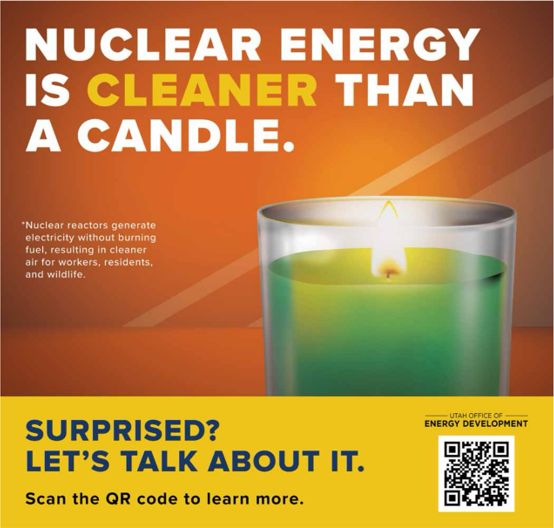
Here are some of the problems I see with this ad:
A candle does not leave behind radioactive waste that remains dangerous for thousands of years.
A candle does not require uranium mining that contaminates land and groundwater.
A candle does not create the possibility of catastrophic accidents like the Chernobyl disaster or the Fukushima Daiichi nuclear disaster.
And a candle does not saddle families and businesses with decades of soaring utility bills, as happened in Georgia beginning May 2024.
Georgians were told The Vogtle expansion was a forward-looking investment in reliable clean energy. Instead, the project became a financial disaster marked by years-long construction delays and exploding costs that led to the bankruptcy of Westinghouse. Georgia Power customers were forced to pay for the project financing during construction of approximately $1000 per household before the first electron was generated. Once the project was completed rates increased 25%, about 10 times higher than the 1-2% rate increases we were told.
Georgia Power is a monopoly and customers have no choice in their utility. Seniors on fixed incomes, working families living paycheck to paycheck, renters, and small businesses were forced to absorb the cost while shareholders remained protected. In 2025 over 270,000 Georgia Power customers were disconnected for inability to pay their high bills, or one in every nine customers. The pain and shock from the high electricity bills led to two commissioner losing their reelection bid and the political fallout continues.
Like Georgia, Utah is a top 10 sunny state. In fact, Utah was recently ranked the second sunniest state in the nation. Despite this enormous natural advantage, Utah barely ranks in the top tier of states for solar deployment. Instead of pouring billions into nuclear energy projects that will take 15 years to complete, as Plant Vogtle did, Utah could become a national leader in solar, coming in 2nd or 3rd place for installed solar instead of 10th. Pair solar with storage, which has dropped 80% in cost in the past five years, and nuclear generation has zero advantage.
Utah could aggressively expand distributed solar generation on homes, schools, parking lots, warehouses, and commercial buildings. It could invest in virtual power plants that connect rooftop solar, batteries, smart thermostats, and electric vehicles into coordinated systems that strengthen the grid during periods of high demand.
These solutions are not futuristic ideas. They are already being deployed successfully in the U.S. and across the world.
Why is nuclear being pitched across the U.S. so heavily? Because it is far more profitable: utilities and nuclear energy corporations like General Electric, Bechtel, and Westinghouse make enormous profits off the high cost of nuclear. Southern Company, the corporate owner of Georgia Power, earned such high profits in 2025 that their CEO termed it as “transformational” during their earnings call, but did not mention that one in nine Georgia Power customers were disconnected that same year.
The nuclear energy industry survives because governments protect it from risks that private investors would never accept. Ratepayers absorb overruns. Taxpayers backstop liability risks. Utilities earn guaranteed profits from construction spending even when projects spiral out of control, as happened in South Carolina for their nuclear project, Plant Summer.
The ad’s slogan also ignores one of the industry’s biggest unresolved problems: radioactive waste. The United States has no permanent disposal solution for spent nuclear fuel. Waste continues accumulating at reactor sites. It is one of the defining failures of the technology.
The real question is not whether a nuclear reactor produces less visible smoke than a candle flame. The real question is whether nuclear power is the smartest, fastest, safest, and most affordable way to build a clean energy future. Georgia’s experience with Plant Vogtle shows it is not: Nuclear power has locked us into decades of high utility costs while preventing or delaying investments in cheaper and more practical alternatives. I urge the people of Utah not to follow our footsteps.

By Patty Durand
On April 30, 2024, Georgia Power finally completed the first new nuclear reactors in the U.S. in 30 years. But for Georgia Power customers, the project did not come with a celebration. It came with a 25% rate increase the day after the two reactors entered commercial service, the largest rate increase in state history. All of this as Georgia Power rakes in record profits, by some accounts as much as 23% of consumer electric bills.
And Plant Vogtle came with its own “Let them eat cake” moment for Georgians: On May 31, 2024, U.S. Energy Secretary Jennifer Granholm joined federal and state officials at a ribbon-cutting ceremony on site in Waynesboro, Georgia. There, she called for building 200 more Westinghouse AP1000 reactors without mentioning the project’s whopping $36 billion price tag, while attendees were literally treated to cake shaped like nuclear reactors. Not only was Secretary Granholm not a Georgia Power customer and thus not impacted, none of the state Public Service Commission (PSC) commissioners regulating Georgia Power were either: they were all Georgia EMC customers.
Regulatory Failure
Throughout construction, as cost overruns ran into the billions of dollars, these same regulators declined to put consumer protections in place, claiming that a thorough review to determine what costs were prudent and reasonable would take place at the end. Yet that final, thorough review never happened. Georgia is one of only five states with no Consumer Utility Counsel or Advocate to represent consumers in complex, billion-dollar rate cases. For Vogtle, that absence had profound consequences: as the project neared completion after 7 years of delay, PSC staff and Georgia Power reached an agreement in private under which nearly all cost overruns would be passed directly to customers, with no public hearings or thorough prudency review.
Because those hearings were never held, there is little national understanding of the drivers of the cost overruns, allowing all kinds of beliefs about new nuclear energy to take root without a factual record. Consultants hired in the spring of 2023 by the commission prepared reports for what were expected to be weeks of cost review hearings that fall. Those reports never saw the light of day, but we know they concluded that most of the cost overruns should not be borne by customers.
Next Time Won’t Be Better
What does that have to do with the national push for new nuclear power underway now? There is a strong belief among proponents that the next time will be different, that a learning curve exists from Georgia’s experience. Claims that Unit 4 was cheaper to build, or that there was any meaningful learning curve, are not backed up by facts or documentation. If that were true reports documenting that amazing outcome would be public and news stories would proliferate, but neither exists.
In fact, nearly every major claim made leading up to and throughout the project was false. Georgia Power claimed for years that Plant Vogtle was on time and on budget when it wasn’t. South Carolina Electric & Gas and Westinghouse made false claims of progress on their twin nuclear project at V.C. Summer, using the same AP1000 reactor design as Georgia, leading to criminal charges and massive fines for both utility and Westinghouse executives when the truth was revealed.
Important Repercussions
The political fallout in Georgia has been significant too. Last November, two Public Service Commissioners who backed Vogtle were removed by voters in decisive elections, the first time in 30 years that Democrats were elected to the commission. The following month, a special election flipped a traditionally Republican-held seat to a Democrat who campaigned on Public Service Commission accountability. And last month, a third Public Service Commissioner, a staunch nuclear power advocate, announced she would not seek reelection.
This is what makes the current push for nuclear power so troubling. It is happening at a time when the economics of energy have fundamentally changed. Renewable energy, especially solar and wind paired with battery storage, is dramatically cheaper and faster to deploy than nuclear power projects. Flexibility is what a modern grid needs now, not the large baseload generating power plants and high voltage transmission lines of the past. By pursuing new nuclear and natural gas for data centers, Georgia is looking backward. Anyone following this path is too.
The truth is that Texas deployed 30 gigawatts of solar generation and 6 gigawatts of storage in just the past four years at a cost of about $36 billion. Georgia deployed 2 gigawatts of nuclear generation over 15 years also at a cost of about $36 billion. That is typical for nuclear power: projects are either cancelled at great cost to ratepayers as in South Carolina, or are built at great cost to ratepayers as in Georgia.
Profits Over People
So why are the voices promoting nuclear generation only growing louder? The answer appears to be an outdated view of the electricity grid among some, and the pursuit of profits among others. This dynamic is clear from the substantial profits that Plant Vogtle delivers to Georgia Power. Westinghouse, Small Modular Reactor (SMR) startups, and other utilities are eager to pursue big profits from nuclear power too. Even more disturbing, the Trump administration announced a $6 billion merger of Trump Media and nuclear fusion company TAE Technologies, while it relaxes nuclear safety protocols that benefit allies.
Plant Vogtle offers a cautionary tale to the country: eighteen months after Georgia Public Service Commissioners enjoyed cake in the shape of nuclear reactors, two of them were gone. This year, a third commissioner will be gone. Elected officials must understand that voters will not reward you for pursuing nuclear power: they will remove you.
Why New Reactors are the Wrong Tools for Decarbonization, a webinar featuring David Schlissel, hosted by Applied Economics Clinic for their Energy, Environment, and Equity Forum on April 22, 2026. Please find the slides here.
The following is an excerpt from an article published recently by the Union of Concerned Scientists and written by Edwyn Lyman, Director, Nuclear Power Safety.
April 26, 2026 marks the 40th anniversary of the Chernobyl Unit 4 nuclear power plant disaster in the former Soviet Union. A toxic combination of defective reactor design, deficient safety analysis, disregard for operating procedures and administrative controls, prioritization of power production over safety, lack of independent regulatory oversight —and, above all, excessive secrecy—led to the worst nuclear reactor accident in history.
Operators botched a safety test and took the reactor into an unstable state, causing a rapid rise in power that triggered violent steam explosions that blew apart the reactor core and surrounding structures. Fires burned for days. A massive amount of radioactivity dispersed across the former Soviet Union and much of Europe. Hundreds of thousands of individuals were evacuated or relocated from contaminated areas, and a 30-kilometer radius “exclusion zone” was established that is still in place today. Dozens of emergency personnel died within weeks from acute radiation syndrome, and thousands of children developed thyroid cancer from radioactive iodine exposure. Ultimately, tens of thousands of cancer cases throughout Europe are projected to occur from the radioactive pollution caused by the disaster.
The United States and many other countries have sought to distance themselves from the potential for a Chernobyl-like accident by asserting that their nuclear regulators would never have licensed a reactor with the safety flaws of the RBMK (a Russian acronym for “high-power channel-type reactor,” the Chernobyl-4 design), and that light-water reactors (LWRs), by far the most common type of power reactor in operation, are far safer. While this argument has some validity, soon after the accident it became clear the safety benefits of LWRs compared to the Chernobyl-4 RBMK were not as great as advertised—a point later illustrated by the 2011 Fukushima Daiichi triple LWR meltdown in Japan. And today, many of the regulatory requirements and standards that underlie this confidence in the safety of the US nuclear fleet are being thrown by the wayside as the Trump administration recklessly pushes to “unleash” nuclear energy as quickly as possible.
Read the full article here.
By Sharon Squassoni
President Donald J. Trump’s recent threats to end civilization in Iran gave many a nuclear weapons expert the jitters. For them, existential threats mean only one thing: use of nuclear weapons. Thankfully, Trump’s April 7, 2026 threats were empty and possibly just a ruse to create a dramatic background for the temporary ceasefire in Iran. To be clear, the use of nuclear weapons in combat would serve no earthly strategic or tactical purpose, but threats to use them can be potent: even a latent capability in the hands of Iran was regarded as too threatening for the United States to tolerate any longer, which reportedly drove the U.S. and Israeli military actions.
It’s hard to tell who’s winning or losing in this conflict, but already it’s clear that disruption of energy sources (Iran’s blocking the Straits of Hormuz and the U.S. and Israel striking Iran’s oil infrastructure) focuses attention like no other infrastructure attack. A sudden cutoff that shrinks supplies and distorts prices echoes in economies across the globe. This is one reason the world was hesitant to impose sanctions on Iran’s oil some twenty years ago when Iran’s clandestine nuclear program was first unveiled. Today, the Iran war has underscored just how dependent the world continues to be on foreign sources of oil.
Would nuclear energy be any different?
Since 2022, there has been a push in Europe and elsewhere to deploy nuclear reactors to reduce dependencies on Russian oil and gas, triggered by Russia’s invasion of Ukraine. But such a response is almost laughable to anyone paying attention to what has transpired in Ukraine in the last four years. Russia hesitated not at all to hold the Chernobyl and Zaporizhzhiya nuclear power plants hostage, in addition to firing upon them. The only thing that has saved Ukraine from a major nuclear meltdown is the fact that Russia wants to save Ukraine for itself, rather than destroy it utterly. Such vulnerability works both ways: in August 2025, an auxiliary transformer at Russia’s Kursk nuclear power plant (the largest in Russia) caught fire after Russian forces shot down Ukrainian drones.
For those who still believe in international laws, there are rules to prevent attacks on nuclear plants — specifically the Protocol I Additional to the Geneva Conventions, a key document in international humanitarian law adopted in 1979 — that 175 countries follow. Unfortunately, Russia withdrew in 2019 and the US has never ratified Protocol I (along with Israel, India, Pakistan, Turkey and Iran). The Protocol protects “works and installations containing dangerous forces,” prohibiting attacks on nuclear power plants that generate civilian electricity, among other things. It concedes that some nuclear power plants that regularly support military purposes may be attacked. For those paying attention to nuclear development trends, this should be worrisome because both China and the United States have programs to develop nuclear reactors for specific military uses. Not content to learn from past experience, the United States plans to deploy a military microreactor by July 4th of this year. Leaving aside questions of cost, safety and peacetime security, such deployments will widen the base of deadly targets in war. Civilians won’t care whether international law deems these “legitimate” targets of attack.
Attacks on nuclear facilities themselves are not new. The United States, Russia, Israel, Iran and Iraq have all, at times, targeted nuclear research and power reactors under various stages of construction and operation in the past. Sometimes these attacks tried to slow nuclear weapons proliferation programs and sometimes, as in the Iran-Iraq war, they were targeted for less specific purposes. After the June 2025 attacks on uranium enrichment-related facilities by the United States, touted as “obliterating” Iran’s nuclear program, International Atomic Energy Agency Director General Rafael Grossi warned that a strike on the Bushehr power plant could cause a regional catastrophe.
Recently, Iran’s Foreign Minister Abbas Araghchi has claimed that the Bushehr plant, which generates close to 1000 Megawatts of electricity, has been struck four times since February this year. The closest hit has been 75 meters from the plant on April 4, killing a security guard and damaging a building. Russia, which has 128 Rosatom personnel at the plant, is considering further evacuations, which sounds eerily similar to what happened to the Zaporizhzhia plant in March 2022.
To create a nuclear disaster, it’s not necessary to directly hit the containment building. Damaging on-site and off-site power necessary for cooling can also have severe repercussions. In the case of Zaporizhzhia, operators shut down reactors to minimize some of the risks. But even reactors in stand-by modes pose radioactive risks in a war zone. The Bushehr power plant is still operating and has spent nuclear fuel on-site in spent fuel pools. Who can forget the video footage of the Fukushima Daiichi nuclear power plant in 2011 when crews attempted to spray seawater from helicopters on spent fuel pools damaged by the earthquake and tsunami that devastated Japan? More than a decade later, the site is still undergoing remediation.
In spite of all this, Director General of the IAEA Grossi promotes rules of the road to help nuclear energy continue operating in warzones. It is a stark reminder that the IAEA’s major mission is to promote nuclear energy, despite the emerging lessons from two “nuclearized” wars.
In fact, learning the wrong lessons from this conflict could carry the seeds of unimaginable future disruption. A world that fears reliance on foreign energy could rely even more on nuclear energy for not just electricity, but transportation and data processing, the new currency of power. The greater the reliance, the keener officials will be to keep it up and running. More and more widely distributed nuclear targets will not be protected by Protocol I of the Geneva Convention, or by the International Atomic Energy Agency. There is no International Nuclear Red Cross or Emergency Management Agency.
Many Americans find it hard to contemplate attacks on U.S. soil, with good reason. This is why the 9/11 attacks affected the population so deeply. Those attacks sparked significant improvements in security at nuclear power plants that are now being unraveled by a push to deploy nuclear reactors in the United States as quickly as possible. The Nuclear Regulatory Commission recently voted to discontinue force-on-force commando drills designed to reveal weaknesses in site vulnerabilities. A victim of the DOGE process, the NRC has been stripped of its independence and will now overhaul the entire licensing process, even as the Trump administration seeks to end-run the NRC by deploying new reactors on government sites owned by the Departments of Energy and Defense.
If anything, the Iran war demonstrates Gulliver’s dilemma. Both Ukraine and Iran have used drones successfully to compensate for conventional force inferiority. Are we truly prepared to counter cheaper and more plentiful attacks that are more difficult to detect and defend against?
Iran’s nuclear program was feared for its potential to provide the basis for nuclear weapons. Now it is generating fear for its potential to provoke a more imminent regional catastrophe, whether intended or accidental. These security risks, perhaps not widely appreciated now, will only grow in a more nuclearized future.
Sharon Squassoni
Research Professor
Elliott School of International Affairs,
The George Washington University