In Georgia, the political fallout from nuclear power is no longer theoretical—it is electoral. On May 19, 2024, state officials enjoyed cake in the shape of nuclear reactors at the Plant Vogtle ribbon cutting in Waynesboro to celebrate the completion of the first two nuclear reactors built in the United States in 30 years. Just 18 months later, two of those pro-nuclear regulators, Commissioners Tim Echols and Fitz Johnson, were gone, ejected in landslide numbers by voters who did not like the huge utility bills that followed. Six months later, a third pro-nuclear regular, Commissioner Trisha Pridemore, announced that she would not run for reelection.

This fallout was of their own making: Plant Vogtle’s total cost of $36 billion marks it as the most expensive power plant ever built on earth. The project went $17 billion over budget and was delivered seven years late. Yet Georgia’s pro-utility regulators had only positive things to say throughout construction, then voted to make customers reimburse Georgia Power for nearly all of Vogtle’s cost overruns while granting them profits far above industry norms. Allowing billions in cost overruns to flow directly into customer bills raised rates a stunning 25%, the largest rate increase in state history, one that will last across the 60-year depreciation schedule for the reactors.

This harmful financial outcome for customers was predictable. Many nuclear energy experts, as well as commission staff, testified both before the project began in 2008 and again in 2017—after massive overruns drove main contractor Westinghouse Electric Company into bankruptcy—that the project should be scrapped. The financial risks for Georgians were too high, they said, and less expensive generation was available. Public opposition was strong too. All were ignored by regulators who voted to continue. 

Meanwhile, as Georgia Power customers experienced high bills, Georgia Power received record profits. The contrast is stark: while customers experience utility bills the size of car payments, in 2024 Georgia Power enjoyed record profits of $2.5 billion, and in 2025 profits were a stunning $2.85 billion. These profits are far higher than a monopoly market delivering an essential commodity, electrons, should earn, and would not earn without state protectionism. 

What comes with high utility bills? High customer disconnections. In 2025, Georgia Power disconnected approximately 275,000 customers, or one in nine Georgia Power households compared to a national average of only 1%.

The irony is striking: Georgia’s state officials celebrate grid reliability while overlooking a fundamental reality—electricity is not reliable for customers who cannot afford it. Even setting aside that Georgia Power’s reliability metrics fall below the national average, when a household is disconnected the grid is no longer reliable for the people it is meant to serve.

The political consequences are now spreading beyond Georgia. Lawmakers in Alabama are advancing proposals to eliminate elections for the Alabama Public Service Commission after watching Georgia voters elect two Democrats from their regulatory body following Vogtle-related rate increases. So rather than adjust energy policy to reduce consumer risk, policymakers seek to reduce voter oversight instead. 

Georgia’s experience demonstrates that when nuclear construction drives electricity prices sharply upward, voters hold regulators accountable. If elections are weakened or eliminated in response to nuclear-driven rate backlash, it signals that policymakers understand the financial risks but prefer to shield regulators from consequences rather than protect customers.

Despite the first nuclear reactor construction project in 30 years going off the rails, several states are now exploring nuclear construction using the same AP1000 reactor design that Georgia Power used. Policymakers in New York, Texas, South Carolina, and Pennsylvania have all discussed, or initiated, pathways for advanced or large-scale nuclear expansion involving Westinghouse technologies.

The discussion is particularly notable in South Carolina given the state’s similar nuclear construction project to Georgia’s. In 2017 that state ended its V.C. Summer nuclear project given that cost overruns had already raised bills nine times with no end in sight. Some South Carolina regulators and Westinghouse officials went to jail or paid hundreds of millions in fines for lying about cost estimates and construction progress.

The job of a commissioner is to balance utility financial viability with affordable bills, but instead Georgia’s regulators allowed costs that ballooned from construction delays, contractor failures, and project mismanagement to be transferred to Georgia Power customers. Georgia regulators thought voters wouldn’t see past their infrastructure promises while they ignored utility bill affordability, but electricity is not a luxury. It is a necessity. When bills rise but profits soar for the utility, voters correctly interpret the situation and move to end the political careers for those driving it.

Georgia’s experience should serve as a warning to those now pursuing nuclear power, few of whom understand what happened in Georgia. When nuclear construction costs spiral – and they always do because nuclear construction is the only generation type that does not go down in cost over time – voters rightfully hold regulators responsible for the surge in electricity bills. Regulators will not be thanked for building nuclear power. They will be removed.

Nuclear fallout reshaped Georgia’s political landscape, propelling two Democrats onto the state’s utility regulatory commission and prompting a third to drop out. 

The lesson is clear: costly energy decisions do not remain confined to regulatory dockets—they are judged at the ballot box. State officials who fail to protect consumers will be replaced. 

Byline: Patty Durand is the founder of Georgians for Affordable Energy, a nonprofit that advocates for fair utility rates and responsible energy policy in Georgia.
By The Nuclear Skeptic

In a significant win for local opposition, the Nuclear Regulatory Commission’s (NRC) Atomic Safety and Licensing Board has granted a petition to intervene in the licensing process for Dow/X-energy’s proposed small modular nuclear reactor (SMR) project, the first of its kind to apply for a construction permit. The decision marks a pivotal victory for the San Antonio Bay Estuarine Waterkeeper, a local environmental advocacy group representing fisherpeople and community members who have long opposed the project and have dealt with water contamination stemming from Dow’s operation in Seadrift, Texas for decades.

The ruling effectively halts the immediate progression of the construction permit application for the Long Mott Generating Station (LMGS). The facility, proposed by Long Mott Energy (LME)—a subsidiary of the chemical giant Dow and Union Carbide (yes, the same Union Carbide responsible for the most deadly environmental disaster in history)—aims to construct four pebble-bed nuclear reactors in Seadrift. While the project has been touted as one of the first of its kind globally, the Licensing Board found that financial concerns raised by local petitioners merit intervention. The Board could ultimately deny the construction permit, placing the future of the Dow/X-Energy collaboration in jeopardy as well as other proposed X-energy reactors, including at the Hanford Nuclear Site on the Columbia River in Washington state. 

At the heart of the Waterkeeper’s successful petition is the contention that LME has failed to demonstrate the necessary financial qualifications to build and operate a nuclear facility safely. These concerns regarding financial viability were sharply underscored by recent corporate developments. Just days prior to the NRC’s decision, Dow announced a “restructuring” involving the elimination of 4,500 jobs, constituting nearly 15 percent of its global workforce. Many of these cuts are slated for Texas, with specific impacts on the Seadrift area. This juxtaposition of mass layoffs with an overly ambitious, capital-intensive nuclear construction project, prone to runaway cost escalations, has fueled the Waterkeeper’s argument that the project lacks the financial stability required for such a high-risk venture.

Despite the admission of their financial contention by the NRC, San Antonio Bay Waterkeeper expressed significant disappointment regarding the NRC’s dismissal of their safety concerns, albeit on a technicality. Nuclear safety expert, Dr. Edwin Lyman, asserted that the proposed X-Energy Xe-100 design—a “first-of-a-kind” pebble-bed reactor—presents unique risks that have not been arguably addressed:

“The Board’s decision to ignore critical evidence and accept Long Mott Energy’s unjustified assertion that containment-free reactors can satisfy NRC’s regulations poses a direct threat to the health and safety of Texans and the broader U.S. public,” said Dr. Edwin Lyman, director of nuclear power safety at the Union of Concerned Scientists (UCS), a nonprofit group. “Long Mott Energy will still need to prove its claims later to obtain NRC operating licenses for these reactors, but even if the fuel proves defective there is no way that the NRC would order the company to retrofit the reactors with containments after they are built.”

According to Dr. Lyman, the fuel balls inside the proposed Dow/X-energy reactor, will become “enormously more radioactive than when they first entered the reactor.” They will become high-level radioactive waste (irradiated or ‘spent’ fuel), which can give a lethal dose in a few minutes if unshielded. 

Texas and the surrounding community should assume that all of the waste will be kept on site indefinitely. Neither LME nor the NRC has even estimated if or how long the waste from pebble bed nuclear reactors can be stored and how dangerous the site will be as soon as the reactors start and for the thousands of centuries the waste stays radioactive.

For the local community, specifically the fishing industry dependent on the health of the San Antonio Bay, the stakes are existential. 

Diane Wilson, the executive director of San Antonio Bay Estuarine Waterkeeper and a 2023 Goldman Environmental Prize winner, emphasized the disconnect between Dow’s economic retreat from the region via layoffs and its simultaneous push for an expensive industrial experiment in South Texas:

“Dow is laying off thousands of Texans while at the same time seeking to build a wildly expensive experimental nuclear reactor in our backyard. (We) won’t stop until this radioactive experiment on South Texas and our bay is terminated.”

“FIRST GET YOUR FACTS STRAIGHT; THEN YOU CAN DISTORT THEM AS MUCH AS YOU WANT,” – Mark Twain

By David Kraft, Director

Nuclear Energy Information Service, Chicago

As a critical component of advancing the nuclear power juggernaut on an ill-informed public, for several years now pro-nuclear cheerleaders have been working feverishly to get state legislatures to repeal state-mandated moratoria on new nuclear plant construction.

The Biden and now Trump Administrations both have lavished tens-of-billions of dollars on promoting the nuclear fetish. Both also turned the Dept. of Energy into a pro bono advertising arm for the nuclear industry, which conducted numerous promo tours, photo ops and produced slick literature and advertisements asserting the “need” for more nuclear power.  

But this promotional effort was not confined to mere government operations.  The mainstream media was heavily incorporated into the effort to once again (our third “Nuclear Renaissance” this century) try to sell nuclear power to the public, by any rationalization necessary (whether truthful or not): a  predicted – if as yet unsubstantiated —  energy shortage from data centers; a “nuclear power gap” with China and other international sellers; minimization of energy efficiency, renewables and storage; promises of reactors that will “eat” radioactive wastes, be meltdown-proof, are fully portable and mass-produced, be “cheap” to build, and provide “cheap” electricity – just to name a few of the promo points.

While all these glittering baubles were dazzling the public and their legislators, virtually no serious mention let alone detailed discussion of the numerous and universally unstated liabilities of nuclear power ever appear – proving that lies of omission can often be worse than lies of commission.

A prime example of this media propaganda campaign was a recent Washington Post editorial (Jan. 15, 2026)., praising Illinois Governor JB Pritzker and the state legislature for finally “seeing the nuclear light” by repealing Illinois’ 39-year old nuclear construction moratorium. As an Illinois nuclear power watchdog organization for 45 years, we wrote a rebuttal op-ed to correct the numerous “facts” of commission and omission in the WaPo’s op-ed on “the ‘facts’ about nuclear energy” here in Illinois – which of course they did not publish.

First, nuclear plant construction moratoria are not “bans.” The enormously significant difference is that construction is conditionally prohibited until the dangerous high-level radioactive waste (HLRW) produced by nuclear plants are given an environmentally responsible final and permanent place for disposal. The federal government was supposed to have provided a facility by 1997.  It failed to do so then, and continues to fail to this day.  Making more waste absent responsible permanent disposal methods is societally unacceptable and environmentally dangerous – a fact government and media nuclear cheerleaders routinely ignore.  We still have no permanent disposal methodology or facility for the ~100,000 tons of HLRW already produced, which grows annually in the U.S. by nearly 2,000 tons.  Building new reactors adding even more waste absent an operational disposal facility is – criminal.

Concerns about radioactive waste disposal are not trivial.  A study conducted by a team of experts which included former Nuclear Regulatory Commission (NRC) Chairwoman Alison Macfarlane determined that, depending on the design, the currently mythical “small modular reactors” (SMRs) would produce 2 to 30 times as much radioactive waste per unit of energy delivered compared to today’s “old fashioned” reactors.

Second, Illinois Governor Pritzker’s stated concerns about a lack of safety are now borne out as totally justified by President Trump’s recent Executive Orders which cut staff at the NRC while simultaneously calling for a quadrupling of nuclear capacity; shift new reactor licensing emphasis to speed over safety; allow for higher levels of “allowable” radiation exposure for the public; and allow DOGE personnel to overrule some NRC licensing decisions.  Recently, the President has suggested that private entities using nuclear power for data centers could get operating licenses within three weeks – as opposed to the years of thorough engineering review it now takes.  What could possibly go wrong?

Pritzker’s concerns about new large reactor costs are borne out by the most recent Lazard’s analysis (June 2025) of levelized costs, indicating new reactors as more expensive than new solar, on- and off-shore wind, and energy storage.  Projected costs for mythical SMRs vary wildly, but seem to be following this same trend.

Polling reports of increased public support should not come as a surprise.  Like all public opinion, it is driven by money spent and media saturation achieved.  Both the Biden Administration and now the Trump junta over the past five years have used the DOE’s bully-pulpit to lavish tens of millions of dollars into promotional nuclear power propaganda directed at the public, and bestowed huge grants to pro-nuclear projects.  Coupled with current panic-peddling over data center electrical demand and rising costs for electricity, and the Trump Administration’s ill-informed and pathologic policies towards viable renewable energy alternatives, they have driven a poorly informed, if not indoctrinated public to the dubious conclusion that new nuclear is a “necessity.”

Finally, not surprisingly the WaPo op-ed joins government and industry nuclear cheerleaders, in being totally silent about the inconvenient nuclear power side effects like nuclear security, environmental justice, just transitions for reactor communities, proliferation impacts, and the fact that wind and solar combined (and more, including storage) produce more electricity both in the U.S. and worldwide than all operating nuclear power reactors – cheaper, and without radioactive waste and nuclear safety/security concerns.

Ironically, it was a FoxNews analyst who once quipped that while facts may change opinions, opinions will NEVER change the facts.  Deliberately cherry picking and omitting inconvenient facts is not journalism, or responsible editorializing – it’s propaganda. It should be treated as such by the public, and with the healthy skepticism it deserves.

By The Nuclear Skeptic

New York Governor Kathy Hochul’s desire to build 5GW of new nuclear power in order to keep New York’s electric bills affordable and meet future energy demand has one pesky problem: the numbers simply don’t add up. That’s the overarching conclusion of a new report authored by the University of Pennsylvania’s Dr. Joseph Romm, which was presented in New York last week. 

Echoing the Trump administration’s desire to revive the nuclear energy industry from its global downturn over the past few decades, Governor Hochul and President Trump appear to be in lock-step in their shared desire to build new nuclear reactors, despite the economic reality that cheaper and faster power alternatives exist and are already being utilized across the globe to meet growing electricity needs. There are a myriad of possible reasons why both politicians believe new nuclear generation is a viable option moving forward, but it’s clear neither are paying attention to what just happened in Georgia  – when two incumbent Republican Public Service Commission (PSC) members were removed from office by voters  following massive increases in consumer electric bills. To be fair, neither Hochul nor Trump will be around to face the music if their plans are realized and New York starts the decades-long process to build 5GW worth of the world’s most expensive source of energy.  

Keeping the lights on and affordable should be a top priority for any politician in the current economic landscape but there is a clear disconnect between major decisions about our future energy grid being made today and the future ramifications of those decisions both economically and electorally. New sources of affordable and clean electricity are needed to power data centers, vehicle electrification and other sources of new demand, but it’s unclear how much electricity is truly needed and how fast. According to AI proponents, New York and the U.S. at large are going to need massive amounts of new electric power and fast. For example, New York’s Master Energy Plan anticipates nearly 40GW of new power needed by 2040, therefore doubling New York’s current energy supply in the next 15 years.

Setting aside the (very real) possibility of the AI data center bubble bursting far before 2040, Hochul and Trump are calling for more nuclear generation to meet energy demand predictions and both have cited nuclear’s “affordability” as reason why. Well, as Romm’s recent report concludes, this is pure fantasy. 

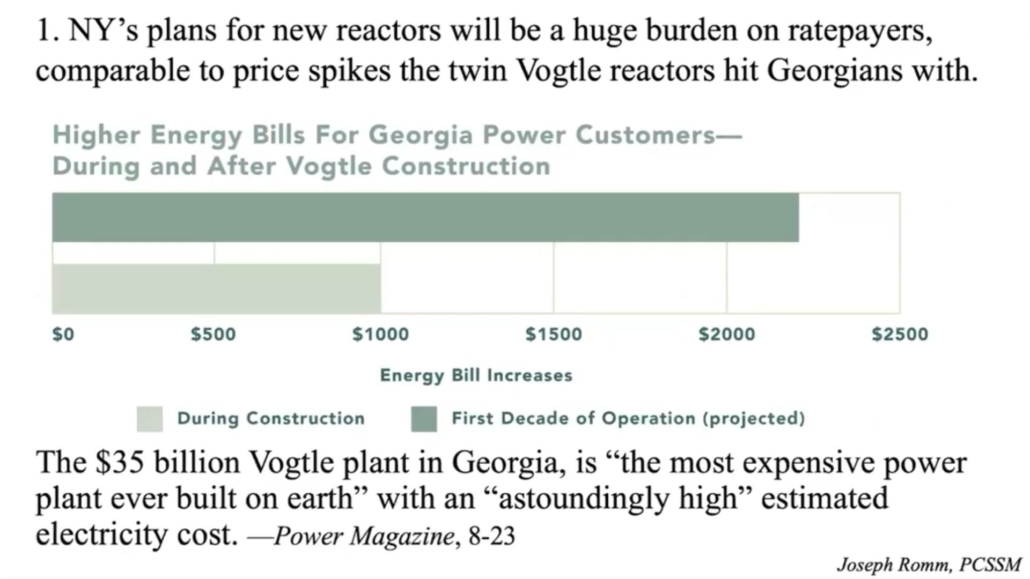
Romm notes that Georgia’s two new reactors at Plant Vogtle, which went online in 2024 after nearly two decades of construction and delays, resulted in a 25% percent increase in consumer electric bills. The ~2GW from the twin Vogtle reactors cost more than $36 billion, 2.5+ times more than original estimates! But that sudden spike in electric bills is just the tip of the iceberg. The recent spike doesn’t account for the billions of taxpayer dollars currently subsidizing the plant, the billions in loans from the Department of Energy used to build it, nor does it account for the high cost of servicing debt and ongoing operations into the future which will inevitably require further subsidization – similar to New York’s $33 billion in state subsidies going towards the existing reactors at Ginna, Nine Mile Point, and FitzPatrick accounting for 5.4GW in capacity. Simply put, Georgia’s two new reactors are the most expensive electricity on the planet and for a myriad of reasons not related to “affordability,” both Trump and Hochul want to recreate that terrible recipe.

But the most disturbing finding in Romm’s report is what was buried in the middle of the NY Master Energy Plan. The plan inexplicably does not include cost or cost overrun figures, instead references a separate analysis used to inform the state’s approach. Hochul’s team, in Trump-like fashion, has decided to ignore its own experts, relying on financial figures included in a separate report by a NYSERDA ‘contractor’ that begins with the unprecedented disclaimer: 

“NYSERDA, the State of New York, and the contractor make no warranties or representations, expressed or implied, as to … the usefulness, completeness, or accuracy of any processes, methods, or other information contained, described, disclosed, or referred to in this report. NYSERDA, the State of New York, and the contractor … will assume no liability for any loss, injury, or damage resulting from, or occurring in connection with, the use of information contained, described, disclosed, or referred to in this report.”

To sum it up, the plan to build 5GW of new nuclear generation in New York is based on an economic analysis that might as well be a science fiction novel. The basic assumption of the “contractors’” economic analysis is that the cost to build reactors in New York, notorious for its cheap construction costs, will be cheaper than at Plant Vogtle in Georgia. Did anyone on Hochul’s team ask Plant Vogtle’s construction monitor if this was achievable? Apparently not. 

Anyone who claims new nuclear power plants in New York will lower your electric bill is lying. We should ask why? Why is Hochul drinking the nuclear kool-aid? I don’t believe New York will actually build and operate a new nuclear reactor any time soon, but like the cancelled-after-spending-$9-billion-dollars twin reactors at South Carolina’s VC Summer, or the abandoned-after-spending-$6-billion dollars reactor at Shoreham which Long Islanders are still paying for, there’s a lot of money still on the table. Our money. 

The full article by Karl Grossman and Harvey Wasserman, originally published on December 24, 2025 in CounterPunch, is available here.

The Trump family is now directly investing in atomic energy.  Its money-losing Truth Social company has become a part owner of a major fusion nuclear power project.

Among much more, the investments mean the Trump family stands to profit directly from White House attacks on wind, solar and other cheap, clean renewable energies which for decades have been driving fusion, fission and fossil fuels toward economic oblivion.

“A Trump-sponsored business is once again betting on an industry that the president has championed, further entwining his personal fortunes in sectors that his administration is both supporting and overseeing,” reported an article on the front page of the business section of the New York Times last week. “This one is in the nuclear power sector. TAE Technologies, which is developing fusion energy, said on Thursday that it planned to merge with Trump Media & Technology Group. President Trump is the largest shareholder of the money-losing social media and crypto investment firm that bears his name, and he will remain a major investor in the combined company.”

The headline of the piece: “Trump’s Push Into Nuclear Is Raising Questions.”

The primary asks have to do with economic conflicts of interest, and public safety.

“The deal, should it be completed,” the article continued, “would put Mr. Trump in competition with other energy companies over which his administration holds financial and regulatory sway. Already, the president has sought to gut safety oversight of nuclear power plants and lower thresholds for human radiation exposure.”

CNN reported: “Nuclear fusion companies are regulated by the federal government and will likely need Uncle Sam’s deep research and even deeper pockets to become commercially viable. The merger needs to be approved by federal regulators—some of whom were nominated by Trump.”

CNN quoted Richard Painter, chief White House ethics lawyer under President George W. Bush, as saying: “There is a clear conflict of interest here. Every other president since the Civil War has divested from business interests that would conflict with official duties. President Trump has done the opposite.” Painter is now a professor at the University of Minnesota Law School.

“Having the president and his family have a large stake in a particular energy source is very problematic,” said Peter A. Bradford, who previously served on the Nuclear Regulatory Commission, the agency meant to oversee the nuclear industry in the United States, in the Times article.

“The Trump administration has sought to accelerate nuclear power technology—including fusion, which remains unproven,” Bradford said. “That support has come in the form of federal loans and grants, as well as executive orders directing the NRC to review and approve applications more quickly.”

Still, the White House press secretary, Karoline Leavitt, said in a statement that “neither the president nor his family have ever engaged, or will ever engage, in conflicts of interest.” And the Times piece continued, “a spokeswoman for Trump Media” said the company was “scrupulously following all applicable rules and regulations, and any hypothetical speculation about ethics violations is wholly unsupported by the facts.”

It went on that “Trump’s stake in Trump Media, recently valued at $1.6 billion, is held in a trust managed by Donald Trump Jr., his eldest son. Trump Media is the parent company of Truth Social, the struggling social-media platform. The merger would set Trump Media in a new strategic direction, while giving TAE a stock market listing as it continues to develop its nuclear fusion technology.”

The Guardian quoted the CEO of Trump Media, Devin Nunes, the arch-conservative former member of the House of Representatives from California and close to Trump, who is currently chair of the President’s Intelligence Advisory Board, saying Trump Media has “built un-cancellable infrastructure to secure free expression online for Americans. And now we’re taking a big step forward toward a revolutionary technology that will cement America’s global energy dominance for generations.” Nunes is the would be co-CEO of the merged company.

A current member of the US House, Don Beyer, a Democrat from Virginia, said in a statement quoted in Politico that the deal raises “significant concerns” about conflicts of interest and avenues for potential corruption. “The President has consistently used both government powers and taxpayer money to benefit his own financial interests and those of his family and political allies. This merger will necessitate congressional oversight to ensure that the U.S. government and public funds are properly directed towards fusion research and development in ways that benefit the American people, as opposed to the Trump family and their corporate holdings.”

By federal law (the Price-Anderson Act of 1957) the US commercial atomic power industry has been shielded from liability in major accidents it might cause. The “Nuclear Clause” in every US homeowner’s insurance policy explicitly denies coverage for losses or damages caused, directly or indirectly, caused by a nuclear reactor accident.

As his company fuses with the atomic industry, Trump acquires a direct financial interest in gutting atomic oversight—which he has already been busy doing. In June Trump fired NRC Chairman Christopher T. Hanson. No other president has ever fired an NRC Commissioner.

Earlier, more than 100 NRC staff were purged by Elon Musk’s DOGE operation. There has been a stream of Trump executive orders calling for a sharp reduction in radiation standards, expedited approval by the NRC of nuclear plant license applications, and a demand to quadruple nuke power in the United States—from the current 100 gigawatts to 400 gigawatts in 2050. Such a move would require huge federal subsidies and the virtual obliteration of safety regulations. Trump has essentially ordered the NRC to “rubber stamp” all requests from a nuclear industry in which he is now directly invested.

Trump’s Truth Social’s fusion ownership stake removes all doubt about any regulatory neutrality. No presently operating or proposed US atomic reactor can be considered certifiably safe.

Read more here.

By Lexi Tuddenham, Executive Director at HEAL Utah

In November 2023, the NuScale/Utah Associated Municipal Power Systems (UAMPS) small modular nuclear reactor (SMR) project collapsed due to cost overruns that would have saddled subscribers with untenable energy costs for untold decades to come. The NuScale project, dubbed by its creators the “Carbon Free Power Project” (CFPP) — was once hailed as the future of energy in Utah. 

Yet over the course of a decade, while the population and energy needs of communities waiting on the promise of its power grew and grew, the only things it actually delivered were shiny presentations and tours of Idaho National Laboratories, where it would have been built. Despite years of planning, and millions of taxpayer and ratepayer dollars spent, the estimated cost of the project had grown 75% from initial estimates from $5.3 billion to $9.3 billion. Just between 2021 and 2023, the price at which the plant would have delivered electricity jumped 53 percent, from about $58 per megawatt-hour (MWh) to $89/MWh. All that with a proposed $4 billion federal subsidy that was bringing down the cost by $30/MWh. Without the subsidy the estimated cost before a single shovelful of actual dirt had actually been moved, was nearly $120/MWh, double the cost of solar energy combined with battery storage

Meanwhile, the estimated time of completion had continuously been pushed further out. In 2015, it was 8 years out. In 2022, it was still eight years out.  

  • When the CFPP was finally terminated, the CEO of NuScale, John Hopkins, famously stated, “Once you’re on a dead horse, you dismount quickly…”. Unfortunately for the communities banking on the energy of the dead horse, there was no easy exit. Those communities who stuck around until the bitter end of the project were spared the high exit fees that were extracted from those who saw the writing on the wall and departed earlier, but they were left scrambling for energy to keep the lights on for growing businesses and families. The main beneficiaries of the entire boondoggle? Investors in NuScale who speculated on the backs of families trying to make ends meet. 

Just two years later it seems clear that we have not learned our lesson here in Utah. At a time when Utah families and businesses are already stretched thin by soaring housing costs, rising groceries, and growing utility bills, our state and utilities are doubling down on risky, slow, and expensive nuclear power projects – the most unaffordable option.  

Back then, we were told these theoretical power plants were for electrification–to clear our dirty air and power the economic vitality of rural communities facing a decline in fossil fuel generation. Now, as the power landscape of the U.S. has shifted with the ballooning of AI data centers and their much-vaunted need for power, we are told that new nuclear development is essential for data centers, and that “energy superabundance” is just around the corner.  

What is not clear in any of this is how communities will benefit. The same pattern repeats itself. Startups naive to nuclear energy production, and even energy production in general, are able to garner millions of dollars infederal subsidies (i.e. your taxpayer dollars) and private investment as they sell their prospective projects to both hyperscalers like Google and Meta and growing communities desperate for energy. Data centers have yet to account for how they will obtain sufficient water for operations, keep ratepayers from paying sky-high rates for electricity, and displace other power needs from the grid. Jobs, community revitalization, and a brighter future are promised to those who most need them. But when the project collapses or the company goes bankrupt, communities are left holding the bag. They still need power, and in some cases are paying for energy they will never get. 

Public transparency is key. 

Here in Utah, Rocky Mountain Power (RMP) recently issued a heavily redacted request to the Public Service Commission to expedite its own power purchase agreement with Bill Gates’ Terrapower Natrium nuclear reactor project in Wyoming. Details that would clarify whether the project might actually provide “system-wide benefits…to ratepayers,” as RMP testified, are marked “confidential.” 

Meanwhile, EnergySolutions, a radioactive and hazardous waste disposal company recently rebranded as a “nuclear energy” company, is actively pursuing a secretive effort to import over 1 million tons of radioactive waste over international borders into the U.S. for permanent disposal. There was limited public information made available about the request, and no local comment opportunity. 

As we are faced with an alphabet soup of new reactor designs and companies, it is essential that we ask key questions. At a bare minimum these should include–what is the company’s experience and expertise in this area? How will a public purchase agreement be designed to protect consumers from ballooning future costs? How will transparency be ensured so that a competitive and fair process transpires and true costs, plans for radioactive waste disposal, and timelines are disclosed and the company advancing them can be held accountable? And how will community risks and benefits be integrated into the decision making process? 

Too often, the nuclear industry and its cheerleaders wave away community concerns, telling people to “trust the experts,” while burying legitimate questions about safety in jargon. If we are to seriously consider nuclear power, we need a clear-eyed assessment of its real costs, risks, and trade-offs. 

Overstating the case for safety and affordability does not serve to bring the people of Utah closer to safe, clean, reliable, affordable, and abundant energy. What is truly needed is an honest reckoning with the facts.

Image of Plant Vogtle courtesy of High & Low Flyer (c) 2024

This opinion editorial by former Plant Vogtle Construction Monitor Don Grace was originally published on November 13, 2025 in Crain’s New York, available here.

Just over a year ago, Georgia completed building two new reactors at Plant Vogtle, making Georgia the first  state to build new reactors in over 30 years. Now that data centers are expanding to serve the needs of artificial intelligence and electrification, there are calls for rapid construction of new nuclear generation, specifically in New York State. But there’s a cautionary tale to be learned for those seeking to build the next nuclear reactor.

New York’s Governor Kathy Hochul announced in June that she was directing the New York Power Authority, the state’s public utility company, to construct a new nuclear facility somewhere upstate with the power capacity of roughly 1000MW, similar to the amount of power produced by the NRC-approved Westinghouse AP1000 reactor used at Plant Vogtle. 

Now, Governor Hochul has requested the Trump administration fast track the new plant, opening the door for New York to greenlight the first nuclear reactor since Plant Vogtle, which was approved for construction in 2012.   

Based on my intimate knowledge of Georgia’s Plant Vogtle project, I believe political enthusiasm for nuclear power as a panacea to our energy needs is misplaced. As a nuclear engineering professional with decades of experience and the Vogtle Construction Monitor for the recently completed reactors, I authored over a dozen reports on the progress and problems of Vogtle in filings to the Georgia PSC and testimony before the commission. In Georgia, energy generated by the new reactors cost $160/MWh, or five times more than the $30/MWh price point at which most utilities can generate electricity. Georgia’s residential ratepayers are now burdened with a 25% rate increase for a modest amount of electricity generated by the new reactors for Georgia Power’s share of the project.

It’s naïve to believe lessons learned from constructing Vogtle’s new reactors will reduce costs for the next ones because the ‘first of a kind’ is always more expensive. Yet Vogtle’s reactor design, the AP1000, is not the first of a kind – it’s a basic pressurized water reactor, a technology from the 1950s where the reactor’s core is cooled by water circulated using electrically powered pumps. There are some nuclear designs underway such as molten salt reactors or small modular reactors which are new, but these designs will not carry any reduced costs from lessons learned from Vogtle.

Even if the next reactor design is similar to Vogtle, the cost to construct the AP1000 reactor was only one of many factors for cost overruns.  A drop in natural gas prices prompted the cancellation of 12 of the originally planned 14 AP1000 reactors, which then resulted in the abandonment of the modular facility which was meant to supply common modules to the plants. Hampered by the lack of experienced nuclear construction labor and an inability to properly manage completion of the project, the construction contractor ultimately declared bankruptcy. 

However, even if natural gas prices hadn’t decreased, the $36 billion cost and 15-year timeline, even if improved 30%, means that nuclear generation is still far more expensive and slower to deliver than any other solution. Georgia’s new reactors support the case that nuclear energy is the only energy technology that has never gotten cheaper over time.

Seventeen years after the Plant Vogtle expansion project first was licensed, it’s clear that new nuclear is not a panacea. The staggering and ever-increasing costs, prolonged construction timeline, and significant burden on ratepayers reveal a technology that commercially speaking, remains fundamentally flawed. And that’s not even touching on the safety and long-term waste storage concerns raised by building new reactors.

The story of Plant Vogtle is not a tale of technological triumph, but a cautionary narrative for states like New York seeking to build a new nuclear reactor. If there are no limits to what is spent, anything can be completed. Until the nuclear industry can demonstrate true cost-effectiveness and technological innovation, it will remain a costly burden for ratepayers and a distraction from the work that is needed to meet our future energy needs. Don Grace served as the Plant Vogtle Construction Monitor from 2017 to 2024, providing oversight and testifying semi-annually before the Georgia PSC. 

Don Grace served as the Plant Vogtle Construction Monitor from 2017 to 2024, providing oversight and testifying semi-annually before the Georgia PSC. 

By Kim Scott

The story of Plant Vogtle’s two new nuclear reactors in Georgia is not a triumph of a “nuclear renaissance”; it’s a cautionary tale written in soaring electric bills and a growing political fallout. The people of Georgia are paying the price, literally, as their utility bills have skyrocketed by over 40% – and now, following last Tuesday’s Public Service Commission election in Georgia, it seems those that allowed this to happen in the first place are starting to feel the pinch as well. It’s about damn time! 

Georgia voters delivered a stunning message by unseating two Republican utility commissioners, Tim Echols and Fitz Johnson, who rubber stamped and championed the costly mistakes leading to a 41% increase in Georgians’ electric bills. This election, which saw Democrats Alicia Johnson and Peter Hubbard championing fair rates, affordability and renewable energy, was a clear referendum on Plant Vogtle’s enormous price tag and more importantly, nuclear power as a not so clean future power resource both here in Georgia and elsewhere. 

The stunning defeat of utility backed incumbents sends a powerful signal to utility regulators nationwide that consumers will not tolerate being forced to pay for multi-billion-dollar nuclear boondoggles. If they aren’t paying attention, Wall Street sure is, downgrading Southern Co.’s stock immediately following the election, citing the increased risk and the new difficulty the company will face in pushing through further rate hikes to pay for Plant Vogtle and other projects in their pipeline. Georgia customers will pay an additional $36 billion to $43 billion over the 60-80 year lifespan of the two Vogtle reactors compared to cheaper alternatives. 

Vogtle stands as the only new nuclear reactor built in the last 30 years, and its fallout offers a bleak prognosis for any supposed “renaissance” and its supporters in statehouses across the country. We can look back to 2017 when the main contractor, Westinghouse, filed for bankruptcy due to the extreme cost overruns at Vogtle. At that critical moment, the Georgia PSC ignored its own staff, energy experts, and public outcry, choosing to burden ratepayers with the project’s continuation.

The consequences of those decisions, subsequent rate increases and soaring electric bills are not abstract—they are impacting the most vulnerable among us and the most overlooked i.e. middle class/working class Georgians. Disconnection rates for the inability to pay have soared by 30% in 2024. For retirees on fixed incomes, the rate increases to pay for Plant Vogtle mean the difference between making ends meet and falling into destitution. This summer, when brutal heat waves descended, vulnerable Georgians had their power shut off, creating life-threatening conditions because they could no longer afford to cool their homes.

The ratepayer backlash in Georgia is also being fueled by the projected massive energy demands of AI data centers, which are forcing utilities like Southern Co. to reckon with costly new generation and transmission projects. Instead of aggressively pushing nuclear power—as evidenced by the Trump administration’s recent $80 billion deal to buy reactors from Westinghouse, the same company bankrupted by Vogtle—we must demand that elected politicians focus on fast and affordable energy solutions like solar and battery energy storage systems. 

The painful lesson learned in Georgia is that new nuclear power is simply too expensive and takes too long. The reality is that for half the cost and in less than a quarter of the time, we could have built more than twice the capacity using solar, wind, or battery storage technologies. But corruption won out and Vogtle is here for the foreseeable future. Georgians will be paying for this mistake for decades to come… I’m just glad there’s finally some accountability headed our way.


Kim Scott is Executive Director of Georgia WAND, is a native Georgian, and has a Chemical Engineering degree from Vanderbilt University in Nashville, TN.

This blog was originally published by Nuclear Information Resource Service (NIRS) on October 30, 2025. View it in full here. Shared with permission.

On Tuesday, the White House announced an $80 billion deal with Westinghouse to finance construction of eight large new reactors in the U.S. There is not enough in the way of actual details about the deal, resulting in even more unanswered questions. But the promise of a large, direct investment in a pack of new reactors has predictably revved up talk of yet another “Nuclear Renaissance” and made it look like the DJT 2.0 administration is making good on big nuclear power goals from a group of executive orders issued in May. 

$80 billion  sure sounds like a lot! And the news that the announced $80 billion is going to come from Japanese taxpayers and not U.S. taxpayers sounds like a sweet deal!

If we were talking about just about any other energy source, it would be a lot. $80 billion could build:

  • 58,000 megawatts of solar power, or
  • 38,000 MW of wind power, or
  • 48,000 MW of wind and solar combined, or 
  • 14,000 MW of geothermal power plants.

Any of those options would produce about the same amount of electricity each year as 14-16 large-sized nuclear reactors – twice as many as the Westinghouse deal promises to build.

But $80 billion is only enough to build, at most, four Westinghouse AP1000 reactors. That’s because the cost of building nuclear reactors is four to 10 times more than wind, solar, or geothermal power. Even wind and solar paired with battery storage are still several times cheaper than new nuclear reactors.  

But where would the other $80+ billion for eight reactors come from? U.S. taxpayers? Ratepayers? In this case, probably taxpayers. The reactors would probably receive low-interest loans from the Department of Energy’s (DOE) loan guarantee program, and, following construction, they would be eligible to claim the Clean Energy Investment Tax Credit, which provides a 30-50% subsidy for the cost of a new energy project. That would mean $80 billion or more in loans up front, and, later, $48-80 billion in rebates from U.S. taxpayers. 

That still means someone will have to pay the cost of $80 billion-112 billion, plus interest, for loans and/or investor returns, plus the costs of operating, fueling, decommissioning, and nuclear waste storage. Taxpayers will likely pay that cost, too. One of the projects that would probably be included in the deal is the proposed four-reactor Donald J. Trump Nuclear Power Plant (DJT NPP), which former Energy Secretary Rick Perry’s new company Fermi, Inc. has proposed. Fermi’s stock price surged on Tuesday after the Westinghouse deal was announced. The DJT NPP is to be built at the DOE’s Pantex nuclear weapons plant in Texas, to power AI data centers that Fermi also plans to build there. The reactors and data centers are likely to be categorized as “critical defense facilities”, per Executive Order 14299. Presumably, federal taxpayers would pay for the data centers and their power bills through DOE’s budget. 

Another feature of the deal is a U.S. government profit-sharing and partial ownership in Westinghouse. The company’s Canadian owners – Brookfield Renewable Partners (BRP, an equity investment firm) and uranium company Cameco – would give the U.S. government a 20% share of Westinghouse profits, after the company earns its first $17.5 billion. Then, if Westinghouse’s corporate value reaches $30 billion, Brookfield and Cameco would have to take Westinghouse public on the stock market – and give the U.S. government at least 8.3% of the company’s stock. 

This would benefit Brookfield and Cameco, but not U.S. taxpayers. Another Brookfield affiliate bought Westinghouse from Toshiba when it went bankrupt in 2017 due to soaring costs of building four AP1000 reactors for utilities in South Carolina and Georgia. The South Carolina reactors (V.C. Summer 2&3) were canceled, and the Georgia reactors (Vogtle 3&4) were completed in 2024, seven years late and $23 billion over budget. Brookfield Business Partners (BBP) was unable to sell Westinghouse after pulling it out of bankruptcy, but after countries started sanctioning Russia over its war on Ukraine, it looked like Westinghouse could replace Russia as the largest supplier of reactor fuel and services, so BBP sold the company to Brookfield Renewable Partners and Cameco. 

Westinghouse’s value hasn’t exactly seen explosive growth, so it has been seeking deals to sell AP1000 reactors in Poland, Ukraine, Slovenia, the Czech Republic, and other countries, in partnership with the U.S. government, which has become increasingly convinced that it must retake global leadership in reactor construction from Russia and China. The Biden administration tried to convince states and utilities that all of the problems with Westinghouse’s AP1000 reactor had been resolved. But still, no state or utility has taken the plunge. 

By now, it is evident that no one is buying Westinghouse’s reactors, so it must be up to the U.S. government to do it. But why? Japan’s offer to pitch in $80 billion will soften the blow to U.S. taxpayers. It may even be enough to build the four reactors Rick Perry wants to name after the president. But we would still end up paying the rest of the cost of too-expensive power and never-ending nuclear waste storage, from reactors that mostly will not be providing electricity to our homes and businesses, but to data centers to power AI. Westinghouse is being passed around like a hot potato and we’ll likely be on the hook when the music stops.

This opinion editorial by Beyond Nuclear’s Kevin Kamps was first published in The Hill on October 6, 2025. Access the article here.

When President Trump and Keir Starmer, prime minister of the United Kingdom, signed a deal to rapidly expand nuclear power in the U.K., nuclear stock prices soared to record highs. But the boom ignores the overwhelming evidence that nuclear is a bad risk.  

The only U.S. reactors built in the last 30 years, Vogtle Units 3 and 4, cost over $35 billion, resulting in the world’s most expensive electricity. Prohibitive cost overruns also sank NuScale, the only U.S. attempt to commercialize small modular reactors. 

Notwithstanding, irrational nuclear exuberance is reaching a pitch. Spiking electricity demand, cratering nuclear regulation, reckless nuclear boosterism and federal attacks on renewables have produced a perfect storm fueling nuclear expansionism. Former regulators warn that with the Nuclear Regulatory Commission now compromised, the storm may blow us onto the rocks. 

Nuclear hubris is so extreme that NASA says it will put a reactor on the moon by 2030. But with regulatory guardrails down, we ought to worry more about preventing a nuclear moonscape on earth. 

One neon danger sign is the rise of “zombie nukes” — restarting old, disused reactors, including those previously shut down for safety reasons. It’s happening at Michigan’s Palisades nuclear plantPennsylvania’s Three Mile Island 1 and Iowa’s Duane Arnold.

Another red flag is so-called “advanced” reactors, including small modular reactors. Contrary to the name, small modular reactors are not new, not always small and probably not modular, comprising 127 different designs that are mostly speculative and haven’t been built yet. 

Small modular reactors aren’t “walk away safe” or carbon-free. Their lower output precludes economies of scale and their construction costs aren’t proportionately smaller than conventional nuclear, so their electricity is costlier. They also produce up to 30 times the waste and leak more neutrons. They emit greenhouse gases and thermal pollution. Subsidizing them and other nuclear undermines renewables and makes climate change worse

Holtec, a privately held firm facing ethical questions and known for hawking (though not yet building) small modular reactors and pioneering zombie nuke restart, was tapped in the U.S.-U.K. deal to develop nuclear-powered data centers in northeast England worth $15 billion. It gained notoriety by buying moribund U.S. nuclear plants cheaply under pretense of dismantling them and then pivoting to convert them back to operations, though it has no experience as a nuclear operator. The Nuclear Regulatory Commission obliged, granting regulatory relief and safety exemptions enabling Palisades to transition from decommissioning to “operations” status.

Holtec also plans to install small modular reactors there, next to a large cache of radioactive waste. It has similar plans for decommissioned nuclear sites it owns in New Jersey, Massachusetts and New York, and it intends to go public in the next few months with an IPO potentially valued at $10 billion. 

What could possibly go wrong? 

A nuclear engineer recently warned the Nuclear Regulatory Commission’s Advisory Committee on Reactor Safeguards that once Palisades is restarted, it could fail within six months, with “unimaginable impacts to the general public,” due to mishandled steam generator tubes or its cracked primary cooling system.

Watchdog groups in Massachusetts, where Holtec wants to install small modular reactors on the closed Pilgrim nuclear site, are decrying a pending energy bill repealing a 1982 state law requiring a permanent repository for radioactive waste, as well as voting up a referendum before any new nuclear can be built. Neither condition is met, but Gov. Maura Healy (D) is bent on small nuclear reactors and nuclear-powered AI data centers anyway. 

At New York’s Indian Point, Holtec proposes to install small modular reactors and restart old, partially dismantled reactors, despite signing an agreement that prohibits even proposing renuclearizing the site without local, county and state support, which it doesn’t have.  

Last year, Holtec sued to block a state law prohibiting it from dumping radioactive water into the Hudson River, which Gov. Kathy Hochul (D) signed. Then nuclear lobbyists went into high gear in Albany, including hiring former Gov. Andrew Cuomo, prompting an ethics complaint. Hochul then flipped, directing the New York Power Authority to build at least 1 gigawatt of new nuclear in the state.

This about-face toward nuclear buildout is happening as the regulatory regime, never robust, is in free fall. Four former Nuclear Regulatory Commission chairs (three in this article), have sounded the alarm. Nuclear Regulatory Commission commissioners testified before Congress that they expect to be fired if they question unsafe reactor designs and fail to rubberstamp them. Former Department of Energy Assistant Secretary Katy Huff and colleagues wrote that making nuclear regulatory decisions “for political reasons” is “setting the U.S. on the fastest path to a nuclear accident. … This is neither hypothetical nor hyperbole.” 

From their mouths to market handicappers’ ears. Amory Lovins wrote recently that nuclear-powered AI centers “may be a trillion-dollar bubble, but it’s sellable until market realities intervene.” The same is true of the harsh realities of nuclear’s inherent dangers. Let’s hope radiological disaster doesn’t intervene before nuclear’s unacceptable risks and costs get priced back in. 
 
Kevin Kamps is the Radioactive Waste Watchdog at Beyond Nuclear.